
Spiritual Friendship
But what happiness, what security, what joy to have someone to whom you dare to speak on terms of equality as to another self; one to whom you need have no fear to confess your failings; one to whom you can unblushingly make known what progress you have made in the spiritual life; one to whom you can entrust all the secrets of your heart and before whom you can place all your plans! What, therefore, is more pleasant than so to unite to oneself the spirit of another and of two to form one, that no boasting is thereafter to be feared, no suspicion to be dreaded, no correction of one by the other to cause pain, no praise on the part of one to bring a charge of adulation from the other. 12. "A friend," says the Wise Man, "is the medicine of life." (1974, 2:11-12)

-----------------------------------------------------------------------
Christian Spirituality and Care of Souls
Christian spirituality means living in the mature wholeness of thegospel. It means taking all the elements of your life-children,spouse, job, weather, possessions, relationships-and experiencingthem as an act of faith. God wants all the material of our lives.(4)
The soul is the essence of the human personality. The cure of souls,then, is the Scripture-directed, prayer-shaped care that is devotedto persons singly or in groups, in settings sacred and profane. It is adetermination to work at the center, to concentrate on the essential.(57)

-----------------------------------------------------------------
The Ultimate Fit

---------------------------------------------------------------
Why we don't grow spiritually
"As spiritual directors we will see this kind of movement [towards God] in our directees. It is certainly reason for rejoicing! But over time, we will also see that the human heart resists this Love, skirts it, moves away from it, and even denies any experience of it.
What accounts for such seemingly contrary behavior? Why would we resist the very One for whom our hearts long? The reason, of course, is simple: Love changes us. Love summons us to grow into the Beloved. And such change —religious tradition calls it "conversion" — threatens the self we identify with and cling to with all our might. When God draws near, we may initially feel consoled, but soon we will discover that God is also a consuming fire, a hammer shattering rock."No one can see me and live," Yahweh warns Moses. God's ways are not our way as Deutero-Isaiah notes.' Taking a path toward God inevitably means
leaving behind much that we hold dear." (Buckley 2012, 61-62)

-------------------------------------------------------------------
God's desire, Our desire
The possibility that God's desires for us will correspond to our own deepest desires is a new thought for many people. But if we assume that God's will is something we will notlike, then we'll be tempted to look for happiness on our own. David Benner writes about this in Sacred Companions:
Ignatius of Loyola suggests that sin is ultimately a refusal to believe that what God wants is my happiness and fulfillment. When I fail to believe this, 1 am tempted to sin—to take my life into my own hands, assuming that I am in the best position to determine what will lead to my happiness. As I become convinced that God wants nothing more than my fulfillment, surrender to his will is increasingly possible.
The possibility that I will actually enjoy what God wants for me is radically different from my own infant-believer understanding of God's will. But it is a very biblical concept. The psalmist David wrote, "Take delight in the Lord, and he will give you the desires of your heart" (Psalm 37:4). My heart's desires, then, are from God. In fact, the desires of my heart may actually reveal the will of God. (Fryling 2009, 111)

---------------------------------------------------------------------
Hospitality

Hospitality, therefore, means primarily the creation of a free space where the stranger can enter and become a friend instead of an enemy. Hospitality is not to change people, but to offer them space where change can take place. It is not to bring men and women over to our side, but to offer freedom not disturbed by dividing lines. It is not to lead our neighbor into a corner where there are no alternatives left, but to open a wide spectrum of options for choice and commitment. It is not an educated intimidation with good books, good stories and good works, but the liberation of fearful hearts so that words can find roots and bear ample fruit. It is not a method of making our God and our way into the criteria of happiness, but the opening of an opportunity to others to find their God and their way. The paradox of hospitality is that it wants to create emptiness, not a fearful emptiness, but a friendly emptiness where strangers can enter and discover themselves as created free; free to sing their own songs, speak their own languages, dance to their own songs, speak their own languages, dance their own dances; free also to leave and follow their own vocation. Hospitality is not a subtle invitation to adopt the lifestyle of the host, but the gift of a chance for the guest to find his own.
--------------------------------------------------------------
Fenelon on One Thing is Needful
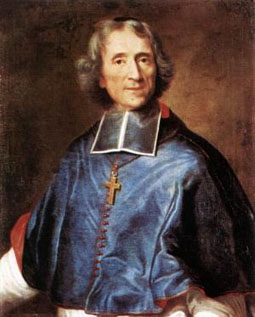
Martha, Martha! You are anxious and troubled about many things; one thing is needful. (Luke 10:41-42 RSV)
We think there are a thousand things we should be concerned with, but there is actually only one. If we take care of that one thing, all the others will find themselves done. And if we fail to take care of the one thing that is needful, all the others—no matter how successfully we may seem to do them—will fall into ruin. So why are we so torn between matters of the heart and our worldly cares?
From this day forward I resolve to give my total attention to the only thing on earth I ought to be concerned with. Illumined by God's holy light, I resolve to stop worrying and to do every moment, with all the strength of my mind and body, whatever God in his providence places in my path. I will not be grieved about turning everything else over to God, because it is not my work I am doing, but God’s. And I ought to want to do only what God gives me to do.
I resolve not to become keenly excited about anything, because it is dangerous to want to appropriate God’s work to ourselves. If we do that, then we do God's work in own strength; we turn good into bad and we allow pride to take over. And then we become flushed with the pursuit of success. We concealed our illusion by using the pretext of seeking God’s glory.
O God, give me the grace to be faithful in my actions, but indifferent to success. The only thing I ought to be concerned with is to desire your will and to quietly meditate on you - even in the midst of busy times. It is up to you to crown my feeble actions with such fruit as is pleasing to you—and none at all, if that is what you find best for me.
--------------------------------------------------------------
Dallas Willard's Sense of Ministry
My sense of ministry is to judge the lay of the land for your times and shoot where the enemy is. The enemy in our time is not human capacity, or over activism, but the enemy is passivity - the idea that God has done everything and you are essentially left to be a consumer of the grace of God, so the only thing you have to do is find out how to do that and do it regularly. I think this is a terrible mistake and accounts for the withdrawal of active Christians from so many areas of life where they should be present. It also accounts for the lack of spiritual growth, for you can be sure that if you do not act in an advised fashion consistently and resolutely you will not grow spiritually.
There is a great collection of his
articles and recordings on
Dallas Willard's website
Rumi's The Guest House
Every morning a new arrival.
some momentary awareness comes
as an unexpected visitor.
Even if they’re a crowd of sorrows,
who violently sweep your house
empty of its furniture,
still, treat each guest honorably.
He may be clearing you out
for some new delight.
meet them at the door laughing,
and invite them in.
because each has been sent
as a guide from beyond.
—translated by Coleman Barks
-------------------------------------------------------------------
Walking Together
can feel like a daily struggle,
a race to accomplish more,
buy more, be more.
Today we pray for the wisdom
to take a step back and look
at the bigger picture.
The true meaning of our journey
is not about earthly things but about
matters of the heart
and longings of the spirit.
We open our arms to those companions
who join us on this pilgrimage of love.
We recognize that we are not meant
to walk this road one by one,
but side by side.
Walking Together: Discovering the Catholic Tradition of Spiritual Friendship by Mary DeTurris Poust, Ave Maria Press, 2010.
-------------------------------------------------------------------------------------------------------------------
Reminder for Surgeons
a notice outside an Operating Theater door in a
hospital which caught my eyes.

---------------------------------------------------------------------------------------------------------------------------
JESUS WENT TO JERUSALEM to announce the Good News to the people of
that city. And Jesus knew that he was going to put a choice before them:
Will you be my disciple, or will you be my executioner? There is no
middle ground here. Jesus went to Jerusalem to put people in a situation
where they had to say yes or no. That is the great drama of Jesus'
passion: He had to wait upon how people were going to respond.
Henri J. M. Nouwen, "A Spirituality of Waiting," The Weavings Reader
----------------------------------------------
I'D ALWAYS KNOWN, in one place in my throat, how Jesus must have cried
in the garden—crying not to die, because there was no fear of death, and
not to leave his friends, because he walked alone, and not to suffer,
because the blood and bruises and thorns were part of his perfection—but
crying because he could not find his Father's face, because when he
would suffer all that he could bear, the pain of every person, living
and dead, in that dark moment, there was really nobody there.
Paul Shepherd, More Like Not Running Away: A Novel
-----------------------------------------------------
IN THE CROSS IS SALVATION, in the Cross is life, in the Cross is
protection from our enemies, in the Cross is infusion of heavenly
sweetness, in the Cross is strength of mind, in the Cross is joy of
spirit, in the Cross is the height of virtue, in the Cross is perfection
of sanctity. There is no salvation of the soul, nor hope of everlasting
life, but in the Cross.
Thomas á Kempis, The Imitation of Christ
------------------------------------------------------
HE DIED, but he vanquished death; in himself, he put an end to what we
feared; he took it upon himself, and he vanquished it; as a mighty
hunter, he captured and slew the lion.
Where is death? Seek it in Christ, for it exists no longer; but it did
exist, and now it is dead. O life, O death of death! Be of good heart;
it will die in us also. What has taken place in our head will take place
in his members; death will die in us also. But when? At the end of the
world, at the resurrection of the dead in which we believe and
concerning which we do not doubt.
Augustine, Sermon 233
-----------------------------------------------------
THERE IS WONDERFUL POWER in the Cross of Christ. It has power to wake
the dullest conscience and melt the hardest heart, to cleanse the
unclean, to reconcile him who is afar off and restore him to fellowship
with God, to redeem the prisoner from his bondage and lift the pauper
from the dunghill, to break down the barriers which divide [people] from
one another, to transform our wayward characters into the image of
Christ and finally make us fit to stand in white robes before the throne
of God.
John Stott, The Preacher's Portrait
EASTER is not the celebration of a past event. The alleluia is not for
what was; Easter proclaims a beginning which has already decided the
remotest future. The Resurrection means that the beginning of glory has
already started.
Karl Rahner, Everyday Faith
Unfettered inquisitiveness, it is clear, teaches better than do
intimidating assignments.
Augustine, Confessions
-------------------------------------------------------
Back to top
The function of education is to make one maladjusted to ordinary
society.
Northrop Frye, quoted in
Michael Dirda, An Open Book: Coming of Age in the Heartland
--------------------------------------------------------------
The end then of learning is to repair the ruins of our first parents by
regaining to know God aright, and out of that knowledge to love him, to imitate
him, to be like him, as we may the nearest by possessing our souls of true
virtue, which being united to the heavenly grace of faith makes up the highest
perfection.
John Milton, "Of Education"
-----------------------------------------------------------------
In academic life the temptation to worship the Part instead of the Whole is
subtle and rationally appealing. In the sciences—natural and social—in the
humanities, we learn an enormous amount of invigorating truth. We know this
search is valid. And therefore it is an aspect of the search for God himself.
But if we stop at halfway houses, if we are content with a likeness of Reality,
then we are bowing before graven images. They are not false, they are only
seductively incomplete.
Gordon W. Allport, Waiting for the Lord: Meditations on God and Man
There are those who desire to acquire knowledge for its own value—and this is a
base vanity. But there are others who desire to have it to edify others—and this
is charity. And there are others who desire it so that they may be edified—and
this is wisdom.
Bernard of Clairvaux, The Song of Solomon
------------------------------------------------------
It's not better teachers, texts, or curricula that our children need most; it's
better childhoods, and we will never see lasting school reform until we see
parent reform.
Samuel Sava, in Leadership
---------------------------------------------------
A little or superficial knowledge of philosophy may incline the mind of man to
atheism, but a further proceeding therein doth bring the mind of man back again.
Francis Bacon, The Advancement of Learning
--------------------------------------------------
Remember: When you talk you only repeat what you already know, but if you listen
you may learn something.
Amish school proverb
---------------------------------------------------
A teacher ought to be a stranger to the desire for domination, vain-glory, and
pride; one should not be able to fool him by flattery, nor blind him by gifts,
nor conquer him by the stomach, nor dominate him by anger; but he should be
patient, gentle, and humble as far as possible; he must be tested and without
partisanship, full of concern, and a lover of souls.
Benedicta Ward, Desert Christian
----------------------------------------------------
IN AUTUMN'S vibrant colors there are reminders of summer's fullness of life, of
winter's impending bleakness, and of the prospect of spring not far beyond.
Autumn compels us to think about life's transience and continuity all in one.
Allen M. Young, Small Creatures and Ordinary Places
------------------------------------------------------
DAYS decrease,
And autumn grows,
Autumn in everything.
Robert Browning, Andrea del Sarto
--------------------------------------------------------
WE THANK Thee, then, O Father, for all things bright and good, / The seed time
and the harvest, our life, our health, and food; / No gifts have we to offer,
for all Thy love imparts, / But that which Thou desirest, our humble, thankful
hearts.
Matthias Claudius, We Plow the Fields and Scatter
----------------------------------------------------------
WHEN the leaves fall, the whole earth is a cemetery pleasant to walk in. I love
to wander and muse over them in their graves. Here there are no lying nor vain
epitaphs. … Let us walk in the cemetery of leaves—this is your true Greenwood
Cemetery.
Henry David Thoreau, Autumnal Tints
------------------------------------------------------------
I SAW old autumn in the misty morn
Stand shadowless like silence,
listening
To silence.
Thomas Hurd, "Ode: Autumn"
--------------------------------------------------------------
FOR the past few years, it has become my custom in autumn to evaluate what needs
to be relinquished in my life. Sometimes possessions weigh me down. At other
times it is my character flaws that burden not only me but everyone who lives
with me as well. I look into my closet and my heart each autumn and ask, "Is
there anything I could surrender that would help me become a freer person?"
Macrina Wiederkehr and Joyce Rupp, The Circle of Life
-----------------------------------------------------------------
Back to top
CHANGE ME, oh God,
Into a tree in autumn.
And let my dying
Be a blaze of glory!
Esther Popel, "October Prayer"
------------------------------------------------------------------
FOR the fruit of all creation, thanks
be to God.
For the gifts to ev'ry nation, thanks
be to God.
For the plowing, sowing, reaping,
silent growth while we are sleeping,
Future needs in earth's safekeeping,
thanks be to God.
Fred Pratt Green, For the Fruit of All Creation
------------------------------------------------------------------
THE GOSPEL message says: "You don't live in a mechanistic world ruled by
necessity; you don't live in a random world ruled by chance; you live in a world
ruled by the God of Exodus and Easter. He will do things in you that neither you
nor your friends would have supposed possible."
Eugene H. Peterson, Five Smooth Stones for Pastoral Work
--------------------------------------------------------------------
I AM GROWING accustomed to the grace of gradual illumination, so it is a delight
and no real surprise when I see God's messages to me in the scattered rainbows
on my wall at sunrise.
Luci Shaw in Weavings
--------------------------------------------------------------------
GOD'S WORD is designed to make us Christians, not scientists, and to lead us to
eternal life through faith in Jesus Christ. It was not God's intention to reveal
in Scripture what human beings could discover by their own investigations and
experiments.
John R. W. Stott, Christian Basics
---------------------------------------------------------------------
SILENCE is one of the deepest disciplines of the Spirit simply because it puts
the stopper on all self-justification. One of the fruits of silence is the
freedom to let God be our justifier. We don't need to straighten others out.
Richard J. Foster, Seeking the Kingdom
----------------------------------------------------------------------
A REALIST is an idealist who has gone through the fire and been purified. A
skeptic is an idealist who has gone through the fire and been burned.
Warren W. Wiersbe in Leadership
----------------------------------------------------------------------
JESUS CHRIST is God's missionary par excellence, and he involves his followers
in his mission.
C. Rene Padilla in Missiology
----------------------------------------------------------------------
YOU COULD SPEAK of Jesus' rising as the most hopeful (hope-full) thing that has
ever happened—and you would be right!
J. I. Packer, Your Father Loves You
------------------------------------------------------------------------
PEOPLE DO NOT drift toward holiness. Apart from grace-driven effort, people do
not gravitate toward godliness, prayer, obedience to Scripture, faith, and
delight in the Lord. We drift toward compromise and call it tolerance; we drift
toward disobedience and call it freedom; we drift toward superstition and call
it faith. We cherish the indiscipline of lost self-control and call it
relaxation; we slouch toward prayerlessness and delude ourselves into thinking
we have escaped legalism; we slide toward godlessness and convince ourselves we
have been liberated.
D. A. Carson, For the Love of God
--------------------------------------------------------------------------
I DON'T WANT to see religious bigotry in any form. It would disturb me if there
was a wedding between the religious fundamentalists and the political Right. The
hard Right has no interest in religion except to manipulate it.
Billy Graham in Parade (1981)
---------------------------------------------------------------------------
ALTHOUGH the threads of my life have often seemed knotted, I know, by faith,
that on the other side of the embroidery there is a crown.
Corrie ten Boom, My Heart Sings
----------------------------------------------------------------------------
IF WE ATTEMPT to comprehend God, the God we think we understand is not God. …
God's presence and activity are beyond our ability to comprehend. We can accept
them with faith. We can be deeply thankful for them. But there is no way we can
grasp them, describe them, and explain them. … The closer we are to God, the
less we know about God.
Pseudo-Macarius, Homilies
--------------------------------------------------------------------------
WHEN THE END comes and we are taken for judgment above, we will then clearly
understand in God the mysteries that puzzle us now. Not one of us will think to
say, "Lord, if it had been some other way, all would be well."
Julian of Norwich, Showings
-----------------------------------------------------------------------
IT IS POSSIBLE to learn all about the mysteries of the Bible and never be
affected by it in one's soul. Great knowledge is not enough.
John Bunyan, The Pilgrim's Progress
---------------------------------------------------------------------
IT IS a serious waste to let a day go by without allowing God to change us.
Richard Rolle, The Fire of Love
-------------------------------------------------------------------
GOD has granted you the morning, but he does not promise the evening. Spend each
day as if it were your last.
Lawrence Scupoli, The Spiritual Combat
-----------------------------------------------------------------
OUR BODIES have one fault: The more we cater to them, the more things they want.
… This is not a trifling matter. God will help us to gain mastery of our bodies.
Teresa of Avila, The Way of Perfection
----------------------------------------------------------------
GOD ALLOWS himself to be seen in ordinary things, even when they are darkened by
shadows.
Jean-Pierre de Caussade, Abandonment to Divine Providence
------------------------------------------------------------------
IF YOU put up with yourself, why not put up with everyone else?
Guigo I, Meditations
-------------------------------------------------------------------
FIRE TESTS IRON; temptation tests an honest person. Sometimes we don't know what
we can do until temptation shows us what we are.
Thomas à Kempis, The Imitation of Christ
---------------------------------------------------------------------
Back to top
THE BEST TEACHERS are trouble and affliction. These alone give us understanding.
John Foxe, Christ Jesus Triumphant
----------------------------------------------------------------------
IT IS NOT POSSIBLE to love an unseen God while mistreating God's visible
creation.
John Woolman, Journal
-----------------------------------------------------------------------
SPRINKLE a seasoning of short prayers on your daily living. If you see something
beautiful, thank God for it. If you are aware of someone's need, ask God to
help. … You can toss up many such prayers all day long. They will help you in
your meditation and in your secular employment as well. Make a habit of it.
Francis de Sales, Introduction to the Devout Life
----------------------------------------------------------------------
I HAVE SEEN a fraction of [God's] glory, and it is awesome.
Bernard of Clairvaux, On the Song of Songs
-----------------------------------------------------------------------
THE BEST TIME to plant a tree was 20 years ago. The second best time is today.
Chinese proverb
------------------------------------------------------------------------
IF YOU are planning for a year,
sow rice.
If you are planning for a decade,
plant trees.
If you are planning for a lifetime,
educate people.
Chinese proverb
-----------------------------------------------------------------------
IF YOU can talk, you can sing;
if you can walk, you can dance.
African proverb
----------------------------------------------------------------------
TELL ME who's your friend, and I'll tell you who you are.
Russian proverb
-----------------------------------------------------------------------
A JOY that's shared is a joy made double.
John Ray, English Proverbs
-----------------------------------------------------------------------
WORRY often gives a small thing a big shadow.
Swedish proverb
------------------------------------------------------------------------
WHEN YOU were born, you cried and the world rejoiced. Live your life in such a
way so that when you die, the world cries and you rejoice.
Indian proverb
-------------------------------------------------------------------------
MONEY IS a good servant but a bad master.
H. G. Bohn, Handbook of Proverbs
-------------------------------------------------------------------------
TIME IN THE SUMMER does not seem to move; instead, time collects, or perhaps it
might be better said to pool. One of the spiritual lessons of summer is just
that: to allow time to pool. To halt in our headlong rush. To be fully in a
particular time. To stop long enough to see what lies around us, rather than to
be always merely glimpsing.
Gary D. Schmidt, Susan M. Felch, editors, Summer: A Spiritual Biography of
the Season
---------------------------------------------------------------------------
THE BEST TEACHERS to help us enjoy summer are little children. They do not yet
work in offices. They do not own calendars with tasks crying out to be done. I
love to see the parks fill up with young life each summer. … I am joining them
for a day, lest I grow old before my time. … As a child, I was quite successful
at living life fully, because I had not yet learned to live by the calendar. I
lived by heart.
Macrina Wiederkehr, The Circle of Life
-----------------------------------------------------------------------------
Back to top
[W]HEN MELODY WELLS UP in thrushes' throats, and bees buzz honeysong, and rock
and river clap like hands in summer sun, then misery's drowned in minstrelsy,
and Godric's glad in spite of it all.
Frederick Buechner, Godric
--------------------------------------------------------------------------
EVERYTHING FLOWS AND stays. You can't step twice into the same river.
Heraclitus, quoted in Plato, Cratylus
-----------------------------------------------------------------------------
IT IS NEVER RIGHT to do wrong or to requite wrong with wrong, or, when we suffer
evil, to defend ourselves by doing evil in return.
Socrates, quoted in Plato, Crito
------------------------------------------------------------------------------
IS THAT WHICH IS HOLY loved by the gods because it is holy, or is it holy
because it is loved by the gods?
Plato, Euthyphro
-------------------------------------------------------------------------------
WHERE SOME PEOPLE are very wealthy and others have nothing, the result will be
either extreme democracy or absolute oligarchy, or desperation will come from
either of those excesses.
Aristotle, Politics
------------------------------------------------------------------------------
IN THE COUNTRY of the blind, the one-eyed man is king.
Desiderius Erasmus, Adages
---------------------------------------------------------------------------
NEW OPINIONS are always suspected and usually opposed without any other reason
but because they are not already common.
John Locke, An Essay Concerning Human Understanding
------------------------------------------------------------------------
WHAT REALLY COUNTS in life is that at some time you have seen something, felt
something, which is so great, so matchless, that everything else is nothing by
comparison, that even if you forgot everything, you would never forget this.
Søren Kierkegaard, Journals and Papers
-------------------------------------------------------------------------
IT IS GOD who is the ultimate reason of things, and the knowledge of God is no
less the beginning of science than his essence and will are the beginning of
beings.
Gottfried Wilhelm Leibniz, Letter on a General Principle Useful in Exploring
the Laws of Nature
------------------------------------------------------------------------
SO ACT as to treat humanity, whether in thine own person or in that of any
other, in every case as an end withal, never as a means only.
Immanuel Kant, Fundamental Principles of the Metaphysics of Ethics
--------------------------------------------------------------------------
HE WHO FIGHTS with monsters might take care lest he thereby become a monster.
And if you gaze for long into an abyss, the abyss gazes also into you.
Friedrich Nietzsche, Beyond Good and Evil
------------------------------------------------------------------------------
WHAT CAN BE SAID at all can be said clearly, and what we cannot talk about we
must pass over in silence.
Ludwig Wittgenstein, Tractatus Logico-Philosophicus
------------------------------------------------------------------------------
THE ART OF BEING WISE is the art of knowing what to overlook.
William James, The Principles of Psychology
--------------------------------------------------------------------------
WHEN PEOPLE ARE FREE to do as they please, they usually imitate each other.
Eric Hoffer, The Passionate State of Mind
-------------------------------------------------------------------------
IT IS ONLY WITH THE HEART that one can see rightly; what is essential is
invisible to the eye.
Antoine de Saint-Exupéry, The Little Prince
-------------------------------------------------------------------------
BEING "RIGHT" ISN'T ENOUGH. We also need to be wise. And loving. And patient.
Perhaps nothing short of that should "seem good to the Holy Spirit and us."
Brian McLaren, as quoted in Leadership
----------------------------------------------------------------------
KNOWING GOD without knowing our own wretchedness makes for pride. Knowing our
own wretchedness without knowing God makes for despair. Knowing Jesus Christ
strikes the balance, because he shows us both God and our own wretchedness.
Blaise Pascal, Pensees
----------------------------------------------------------------------
A CHRISTIAN cannot win God's forgiveness, but he can lose it by refusing to
extend it to a brother.
John P. Meier, The Vision of Matthew
----------------------------------------------------------------------
I NO LONGER CLUTCH at things
that are not mine.
I see that all is gift and all is thine.
A holier hunger hollows me, a thirst
for thee,
a longing to be godly, loving, free.
Barbara Cawthorne Crafton, Blessed Paradoxes
--------------------------------------------------------------------
LET GO of a small part of your righteousness, and in a few days, you will be at
peace.
Abba Poemen, Sayings of the Fathers
-------------------------------------------------------------------
GOD WILL COMFORT US. That is true. But God will, and already does, comfort us
through all those who accept us as sisters and brothers, bind up our wounds,
wipe away our tears, and are kind to us in all circumstances. That is how God
comforts us.
Gerhard Lohfink, The Work of God Goes On
-----------------------------------------------------------------
NOURISH BEGINNINGS, let us
nourish beginnings.
Not all things are blest, but the
seeds of all things are blest.
The blessing is in the seed.
Muriel Rukeyser, "Elegy of Joy," The Green Wave
-------------------------------------------------------------------
LOSS IS TRANSFORMATIVE if it is met with faith. Faith is our chance to make
sense of loss, to cope with the stone that rolls around in the hollow of our
stomachs when something we loved, something we thought was forever, is suddenly
gone.
David J. Wolpe, Making Loss Matter
------------------------------------------------------------------
HOW ELSE but through a broken heart may Lord Christ enter in?
Oscar Wilde, The Ballad of Reading Gaol
(this portion is courtesy of Dr. Amar and Dr. Im)
My brother, may the Son of God who is already formed in you, grow in you so that
for you he will become immeasurable, and that in you he will become laughter,
exultation, the fullness of joy which no one will take from you.
- Isaac of Stella -
----------------------------------------------------------
The prayer that You require of me must be ultimately just a patient waiting for
You, a silent standing by until You, who are ever present in the inmost center
of my being,
open the gate to me from within.
In this way I shall be able to enter into myself, into the hidden sanctuary of
my own being, and there, at least once in my life,
empty out before You the vessel of my heart’s blood.
That will be the true hour of my love.
- Karl Rahner -
(“Encounters with Silence” p.24)
------------------------------------------------------------
In one sense we are always traveling, and traveling as if we did not know where
we were going. In another sense we have already arrived. We cannot arrive at the
perfect possession of God in this life, and that is why we are traveling and in
darkness. But we already possess Him by grace, & therefore in that sense we have
arrived
& are dwelling in the light.
But oh! How far have I to go to find You
in Whom I have already arrived!
- Thomas Merton -
(“A Thomas Merton Reader” p. 513)
------------------------------------------------------------
To live a spiritual life we must first find the courage to enter into the desert
of our loneliness and to change it by gentle and persistent efforts into a
garden of solitude. This requires not only courage but also a strong faith. As
hard as it is to believe that the dry desolate desert can yield endless
varieties of flowers, it is equally hard to imagine that our loneliness is
hiding unknown beauty. The movement from loneliness to solitude, however, is the
beginning of any spiritual life because it is the movement from the restless
sense to the restful spirit, from the outward-reaching cravings to the
inward-reaching search, from the fearful clinging to the fearless play.
- Henri JM Nouwen -
(“Reaching Out” p.35)
-------------------------------------------------------------
Now to tread the spiritual path we must learn to be silent. What is required of
us is a journey into profound silence. .... To be silent with another person is
a deep expression of trust and confidence and it is only when we are unconfident
that we feel compelled to talk. To be silent with another person is truly to be
with that other person.
- John Main -
(as quoted in “Spiritual Classics” p.156)
Through the discipline of silence, then, we are learning to place our reputation
in God’s hands. We no longer need to be sure everyone understands us or thinks
well of us. We let go of even needing to know what they think of us. We are
silent. Interestingly, we come to value words more in times of silence. This is
because we are no longer cheapening words by overuse. We are still, and in the
stillness we are creating an open, empty space where God can draw near. And in
this stillness we just may hear God’s voice in his wondrous, terrible, loving,
all-embracing silence.
- Richard Foster -
(“Spiritual Classics” p.158, 159)
------------------------------------------------------------------
The paradox of prayer is that we have to learn how to pray while we can only
receive it as a gift. ..... We cannot truly pray by ourselves, but that it is
God’s spirit who prays in us.
We cannot force God into a relationship. God comes to us on his own initiative,
and no discipline, effort, or ascetic practice can make him come. All mystics
stress with an impressive unanimity that prayer is ‘grace’, that is, a free gift
from God, to which we can only respond with gratitude. But they hasten to add
that this precious gift indeed is within our reach. In Jesus Christ, God has
entered into our lives in the most intimate way, so that we could enter into his
life through the Spirit.
- Henri JM Nouwen -
(“Reaching Out” p. 115)
-------------------------------------------------------------------
.... For the more we receive in silent prayer, the more we can give in our
active life. We need silence to be able to touch souls. The essential thing is
not what we say, but what God says to us. ..... Only in the silence of the
heart, God speaks.
- Mother Teresa –
(“Total Surrender” p. 107)
---------------------------------------------------------------
I used to think such negative feelings were a sign of failure. Now I realize how
wrong I was, for God is the God of surprises who, in the darkness and the tears
of things, breaks down our false images and securities. This in-breaking can
feel to us like disintegration, but it is the disintegration of the ear of
wheat: if it does not die to bring new life, it shrivels away on its own.
Through this painful in-breaking of the God of surprises, truths of Christian
faith with which I was familiarly bored, or doubted, began to take on new
meaning. As God breaks down the cocoon of our closed minds, he enters it. He is
no longer remote and out there, no longer dwells only in tabernacles and temples
of stone, but we meet him smiling at us in our bewilderment, beckoning to us in
our confusion and revealing himself in our failure and disillusion as our only
rock, refuge and strength.
- Gerard W Hughes -
(“God of Surprises” p. xiii, xiv)
-----------------------------------------------------------------
The mystery of love is that it protects and respects the aloneness of the other
and creates the free space where he can convert his loneliness into a solitude
that can be shared. In this solitude we can strengthen each other by mutual
respect, by careful consideration of each other’s individuality, by an obedient
distance from each other’s privacy and by a reverent understanding of the
sacredness of the human heart. In this solitude we encourage each other to enter
into the silence of our innermost being and discover there the voice that calls
us beyond the limits of human togetherness to a new communion. In this solitude
we can slowly become aware of a presence of him who embraces friends and lovers
and offers us the freedom to love each other, because he loved us first.
- Henri JM Nouwen -
(“Reaching Out” p. 44)
------------------------------------------------------------------
If we really could see into the depths of ourselves and into our subconscious
and unconscious minds, we would recognize in ourselves all the characteristics
of the demoniac and this would terrify us, but we would see also other qualities
which would delight us. There is no crime, no perversion, no cruelty ever
practiced of which we are not capable, but there is also no heroism,
selflessness or love which is beyond our potential. Because we are afraid of
looking at the evil possibilities in us, we fail also to see our true greatness.
Refusing to look at our inner lives, we ignore our true selves, renounce our
individuality, our freedom, our personality, or, as the Jerusalem Bible puts it,
‘we lose our very selves’.
We refuse to acknowledge our own inner chaos because we are all afraid of
rejection.
- Gerard W Hughes -
(“God of Surprises” p.28)
-------------------------------------------------------------------
There is an intimate link between the contemplative spirit and pain. We have a
special mission. Our lives are not an escape from pain. It is not for us to run
away from the pain of the world but somehow to hold onto it. It is important to
hold in our prayer those who are stretched beyond their limits.
We can only do that if we become like Jesus and if we love the Father. Let Jesus
love and live inside us. ‘The secret things of God are hidden.’
The great secret is that in this world of pain and division, he comes and wants
to reveal himself to us. He wants to say to us, ‘I wish to rest in you’. This is
a beautiful secret.
- Jean Vanier -
(“Treasures of the heart” p.1)
-------------------------------------------------------------------
We are called to be contemplatives in
the heart of the world by:
- seeking the face of God in everything, everyone, everywhere, all the time, and
his hand in every happening, and especially,
- seeing and adoring the presence of Jesus in the
lowly appearance of bread, and in the distressing disguise of the poor,
by praying the work, that is,
by doing it with Jesus, for Jesus, and to Jesus.
- Mother Teresa -
(“Total Surrender” p. 97)
-------------------------------------------------------------
It is always the same Christ who says:
I was hungry - not only for food, but for peace that comes from a pure heart.
I was thirsty - not for water, but for peace that satiates the passionate thirst
of passion for war.
I was naked - not for clothes, but for the beautiful dignity of men and women
for their bodies.
I was homeless - not for a shelter made of bricks, but for a heart that
understands,
that covers, that loves.
- Mother Teresa -
(“Total Surrender” p.150-151)
---------------------------------------------------------------
Complete sincerity is an unattainable ideal. But what is attainable is the
periodic moment of sincerity, the moment, in fact, when we confess that we are
not as we have sought to appear; and it is at those moments that we find contact
with God once more.
The progress of our spiritual life is made up of these successive discoveries,
in which we perceive that we have turned away from God instead of going towards
him. That is what makes a great saint like St Francis of Assisi declare himself
chief among sinners.
- Paul Tournier -
(“Reflections” p. 116,117)
--------------------------------------------------------------
If you desire intimate union with God you must be willing to pay the price for
it. The price is small enough. In fact, it is not even a price at all: it only
seems to be so with us. We find it difficult to give up our desire for things
that can never satisfy us in order to purchase the One Good in Whom is all our
joy - and in Whom,
moreover, we get back everything else that we have renounced besides!
The fact remains that contemplation will not be given to those who willfully
remain at a distance from God, who confine their interior life to a few routine
exercises of piety and a few external acts of worship and service performed as a
matter of duty. Such people are careful to avoid sin. They respect God as a
Master. But their heart does not belong to Him.
- Thomas Merton -
(as quoted in “Spiritual Classics” p. 18, 19)
--------------------------------------------------------------------
But the solitude that really counts is the solitude of heart; it is an inner
quality or attitude that does not depend on physical isolation. On occasion this
isolation is necessary to develop this solitude of heart, but it would be sad if
we considered this essential aspect of the spiritual life as a privilege of
monks and hermits. It seems more important than ever to stress that solitude is
one of the human capacities that can exist, be maintained and developed in the
centre of a big city, in the middle of a large crowd and in the context of a
very active and productive life. A man or woman who has developed this solitude
of heart is no longer pulled apart by the most divergent stimuli of the
surrounding world but is able to perceive and understand this world from a quiet
inner centre. ...... When we live with a solitude of heart, we can listen with
attention to the words and the worlds of others, but when we are driven by
loneliness, we tend to select just those remarks and events that bring immediate
satisfaction to our own craving needs.
- Henri JM Nouwen -
(“Reaching Out” p. 38,39)
------------------------------------------------------------------
Here we touch the heart of prayer since here it becomes manifest that in prayer
the distinction between God’s presence and God’s absence is no longer really
distinguishable. In prayer, God’s presence is never separated from his absence
and God’s absence is never separated from his presence. His presence is so much
beyond the human experience of being together that it quite easily is perceived
as absence. His absence, on the other hand, is often so deeply felt that it
leads to new sense of his presence.
- Henri JM Nouwen -
(“Reaching Out” p. 117)
-----------------------------------------------------------------
Jean Vanier, the Canadian who founded a worldwide network of communities for
mentally disabled people, has remarked more than once that Jesus did not say:
‘Blessed are those who care for the poor’, but ‘Blessed are the poor’. Simple as
this remark may seem, it offers the key to the kingdom.
Once I asked Jean Vanier: ‘How do you find the strength to see so many people
each day and listen to their many problems and pains?’ He gently smiled and
said: ‘They show me Jesus and give me life.’ Here lies the great mystery of
Christian service. Those who serve Jesus in the poor will be fed by him whom
they serve: ‘He will put on an apron, set them down at table and wait on them’
(Luke 12:37).
- Henri JM Nouwen -
(“Here and Now: Living in the Spirit” p.69,70)
-------------------------------------------------------------------
Praying means, above all, to be accepting toward God who is always new, always
different. For God is a deeply moved God whose heart is greater than ours. The
open acceptance of prayer in the face of an ever-new God makes us free. In
prayer, we are constantly on the way, on a pilgrimage. On our way, we meet more
and more people who show us something about the God whom we seek. We will never
know for sure if we have reached God. But we do know that God will always be new
and that there is no reason to fear.
- Henri JM Nouwen -
(“With Open Hands” p. 55)
--------------------------------------------------------------
One of the early Christian writers describes the first stage of solitary prayer
as the experience of a man who, after years of living with open doors, suddenly
decides to shut them. The visitors who used to come and enter his home start
pounding on his doors, wondering why they are not allowed to enter. Only when
they realize that they are not welcome do they gradually stop coming.
This is the experience of anyone who decides to enter into solitude after a life
without much spiritual discipline. At first, the many distractions keep
presenting themselves. Later, as they receive less and less attention, they
slowly withdraw.
- Henri JM Nouwen -
(as quoted in “Devotional Classics” p. 138)
----------------------------------------------------------------
When we pray, we allow God to live within us, so that at the deepest level it is
God’s Spirit who does the praying in us and through us.
Soren Kierkegaard says ‘Prayer does not change God, but it changes him who
prays’.
- James Houston -
(“The Transforming Friendship” p.6,7 )
------------------------------------------------------------
The real enemy is in ourselves, in our flight from the God of compassion into
the security of a god of wealth, power and status, both individual and national.
God is a disturbing God. Our temptation in all religion and in all spirituality
is to domesticate God, to create a God who favours us, our group, our nation,
our Church, and who overthrows our enemies. But God is the God who has
compassion for all creation, whose living spirit is in all; a God who breaks
down in us all our comforting prejudices and false securities, religious and
secular. This is very painful for us, but it is the pain of rebirth.
“God is”, in St Augustine’s words, “closer to me than I am to myself.” The
encouraging note I can end with is that God is in all things, in every
individual: the best which I can give to any reader is that you let God be the
God of compassion to you, and through you.
- Gerard W Hughes (“God of Surprises” p.xii) -
------------------------------------------------------------
There are layers upon layers of consciousness within us and on our journey
towards God we are constantly discovering areas of atheism within us, provided
we dare to look. These discoveries are signs of progress, not of failure.
That is why so many of the saints, guilty of no serious wrongdoing in their
lives, think of themselves as great sinners. They have reached inner depths of
sinfulness in themselves of which most of us are blissfully unaware. They are
amazed and full of gratitude to God, who accepts them in their darkness and
sinfulness, while those of us who have not reached those depths may be delighted
and full of gratitude at our own virtuous respectability.
- Gerard W Hughes -
(“God of Surprises” p.64, 65)
----------------------------------------------------------
Clement of Alexandria said that ‘prayer is keeping company with God’. This began
to give me a new focus on prayer. I began to see prayer more as a friendship
than a rigorous discipline. It started to become more of a relationship and less
of a performance. At the same time I learned another important truth: that God
calls us to our Achilles heel, where we limp most, to lead us through our
natural weakness or woundedness of personality, to grow spiritually strong.
After this discovery, I made up my mind that the desire to pray and keep company
with God would become my primary concern in life. Prayer would come even before
my public ministry.
- James Houston -
(“The Transforming Friendship” p.6,7 )
-----------------------------------------------------------
Prayer is a matter of theology and ethics, both thinking and doing: it is
profoundly guided by what we believe and by how we behave. The character of our
prayers will be deeply determined by the character of God as we know him and
have experienced him. The emotional education we have had since childhood will
set the tone for our attitudes to God. So it is true to say: ‘tell me who your
God is and I will tell you how you pray’.
- James Houston -
(“The Transforming Friendship” p.6,7 )
--------------------------------------------------------
Silence is the home of the word. Silence gives strength and fruitfulness to the
word. We can even say that words are meant to disclose the mystery of the
silence from which they come. The Taoist philosopher Chuang Tzu expresses this
well in the following way:
‘The purpose of a fish trap is to catch fish and when the fish are caught, the
trap is forgotten. The purpose of a rabbit snare is to catch rabbits. When the
rabbits are caught, the snare is forgotten. The purpose of the word is to convey
ideas. When the ideas are grasped, the words are forgotten. Where can I find a
man who has forgotten words? He is the one I would like to talk to.’
‘I would like to talk to the man who has forgotten words.’ That could have been
said by one of the Desert Fathers. For them, the word is the instrument of the
present world and silence is the mystery of the future world. If a word is to
bear fruit it must be spoken from the future world into the present world. The
Desert Fathers therefore considered their going into the silence of the desert
to be a first step into the future world. From that world their words could bear
fruit, because there they could be filled with the power of God’s silence.
In the sayings of the Desert Fathers, we can distinguish three aspects of
silence. All of them deepen and strengthen the central idea that silence is the
mystery of the future world. First, silence makes us pilgrims. Secondly, silence
guards the fire within. Thirdly, silence teaches us to speak.
- Henri JM Nouwen -
(“The Way of the Heart” p. 40, 41)
-------------------------------------------------------------
The third way that silence reveals itself as the mystery of the future world is
by teaching us to speak. A word with power is a word that comes out of silence.
A word that bears fruit is a word that emerges from the silence and returns to
it. It is a word that reminds us of the silence from which it comes and leads us
back to that silence. A word that is not rooted in silence is a weak, powerless
word that sounds like a ‘clashing cymbal or a booming gong’ (1 Corinthians
13:1).
All this is true only when the silence from which the word comes forth is not
emptiness and absence, but fullness and presence, not the human silence of
embarrassment, shame, or guilt, but the divine silence in which love rests
secure.
- Henri JM Nouwen -
(“The Way of the Heart” p. 47)
-----------------------------------------------------------------
Silence has a psychological aspect. For me it means listening to God, but for
others it may represent a way of deepening self-knowledge.
I have often had occasion to share silence with others. I can say in general
that it is the less sophisticated person who understands best. A rustic who
decides to listen in to God can in five minutes make you a list of all his
problems, which a professor of philosophy would be incapable of doing. Children
understand straight away, too. The naked truth comes out. We are dealing with
simple matters, and modern people have lost their understanding of such things.
- Paul Tournier -
(as quoted in “Spiritual Classics” p. 162)
-------------------------------------------------------------------
The more I am persuaded of the importance of seeking God’s will for oneself, the
more skeptical I become about the possibility of saying what is his will for
others. That is the source of all kinds of intolerance and abuse. People who
claim to know what is God’s will try to impose it upon others with the arrogance
which comes from the conviction that they are the repositories of divine truth.
I avoid that at all costs. I can never know what is God’s will for someone else.
Even in psychoanalysis doctors generally prefer that their patients should make
their own discoveries. If doctors start making suggestions of their own, they
almost always go astray.
- Paul Tournier as quoted in “Spiritual Classics” p. 162, 163 -
---------------------------------------------------------------
To be mindful is to live in the present moment, not to be imprisoned in the past
nor anticipating a future that may never happen.
When we are fully aware of the present, life is transformed and strain and
stress disappear.
So much of modern life is a feverish anticipation of future activity and
excitement. We have to learn to step back from this into the freedom and
possibility of the present.
Bede Griffiths
-------------------------------------------------------------
The church's leaders have Alzheimer's disease. We still love them. We remember and pas on their stories.But they're living in another world. They're totally clueless about the world that is actually out there. The problem is that they are captaining the ship
Leonard Sweet, Post-Modern Pilgrims
--------------------------------------------------------------
God became a man for this purpose: since you, a human being, could not reach
God, but you can reach other humans, you might now reach God through a man. And
so the man Christ Jesus became the mediator of God and human beings.
God became a man so that following a man—something you are able to do—you might
reach God, which was formerly impossible to you.
Augustine, Commentary on Psalm 134, 5
-------------------------------------------------------------
Shane Claiborne, who spent a summer in the slums of Calcutta
with Mother Teresa, wrote the following about one of his experiences there:
People often ask me what Mother Teresa was like. Sometimes it's like they wonder
if she glowed in the dark or had a halo. She was short, wrinkled, and precious,
maybe even a little ornery—like a beautiful, wise old granny. But there is one
thing I will never forget—her feet. Her feet were deformed. Each morning in
Mass, I would stare at them. I wondered if she had contracted leprosy. But I
wasn't going to ask, of course. "Hey Mother, what's wrong with your feet?"
One day a sister said to us, "Have you noticed her feet?" We nodded, curious.
She said: "Her feet are deformed because we get just enough donated shoes for
everyone, and Mother does not want anyone to get stuck with the worst pair, so
she digs through and finds them. And years of doing that have deformed her
feet." Years of loving her neighbor as herself deformed her feet.
This is the kind of fasting that creates the divine longing for justice, where
our feet become deformed by a love that places our neighbors above ourselves.
Shane Claiborne, The Irresistible Revolution (Zondervan, 2006), p.167-168
--------------------------------------------------------------
Look wise, say nothing, and grunt. Speech was given to conceal
thought.
Sir William Osler
Shut out all of your past except that which will help you weather your
tomorrows.
Sir William Osler
The greater the ignorance the greater the dogmatism.
Sir William Osler
To study the phenomenon of disease without books is to sail an uncharted sea,
while to study books without patients is not to go to sea at all.
Sir William Osler
One of the first duties of the physician is to educate the masses not to take
medicine.
Sir William Osler, Aphorisms from his Bedside Teachings (1961) p. 105
The desire to take medicine is perhaps the greatest feature which distinguishes
man from animals.
Sir William Osler, In H. Cushing, Life of Sir William Osler (1925)
Live neither in the past nor in the future, but let each day's work absorb your
entire energies, and satisfy your widest ambition.
Sir William Osler, to his students
----------------------------------------------------------
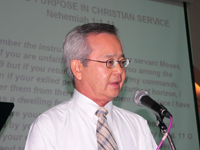
In his sermon to Holy Light Church on “Vision and Purpose in Christian Service”,
Reverend Nicholas Yeo says,
In prayer exercise, am still a learner;
prayer is battering not chattering;
prayer is battle not prattle;
prayer is working not wording;
prayer is warring not boring;
prayer is fight not flight;
prayer is rooted in promises of God & in covenant of the blood;
we have reasons given to us by God in his Word why he should answer, & we can read them there. That's why Nehemiah's prayer was answered – based on God's purposes & God's promises; our prayers ought to be like that, so that God's purposes may be realized; but more often we hear prayers just asking God to bless the work, to bless the sick ones, to keep us plugging along, to keep the work going.
Read more
-----------------------------------------------------
----------------------------------------------------
A pilgrim looked at the reflection of a mountain in still water. It was the reflection that first caught his attention. But presently he raised his eyes to the mountain. Reflect Me, said his Father to him, then others, will look at you. Then they will look up, and see Me. And the stiller the water the more prefect the reflectionAmy Carmichael
--------------------------------------------------
John R. W. Stott,
JESUS KNOWS all about the others, too, the representatives and preachers of the national religion, who enjoy greatness and renown, whose feet are firmly planted on the earth, who are deeply rooted in the culture and piety of the people and molded by the spirit of the age. Yet it is not they, but the disciples who are called blessed—theirs is the kingdom of heaven.
Dietrich Bonhoeffer,
GOD DOES NOT force his kingdom upon anybody but gladly gives it to all who know they're losers without him and humbly seek his help.
Clarence Jordan,
IT IS REALLY only the poor in spirit who can, actually, have anything, because they are the ones who know how to receive gifts. For them, everything is a gift.
Simon Tugwell,
THE KINGDOM of God can only be received by empty hands. Jesus warns against (a) worldly self-sufficiency: you trust yourself and your own resources and don't need God; (b) religious self-sufficiency: you trust your religious attitude and moral life and don't need Jesus.
Michael H. Crosby,
WE ARE to be spiritually poor only for the sake of becoming spiritually rich, detached from what we can own so that we can be attached in a different way to what we cannot own, detached from consuming so that we can be consumed by God.
Peter Kreeft,
IT IS a theological mistake to seek suffering for its own sake. Nor does this beatitude mean that to live a pious life is to embrace the ultimate form of delayed gratification��suffering now in the hope that God will provide the reward once one is dead. The words of the Beatitudes are in the present tense: "Theirs is the kingdom of heaven."
Daniel P. Sulmasy,
HUMILITY, or poverty of spirit, is not a matter of thinking low thoughts about ourselves. It is not a matter of groveling in the dust. It is simply a matter of knowing ourselves as we really are. And when we see ourselves as we really are, we will see that we are poor.
John W. Miller,

"Today I meet Christians who despair over the absence of reality in their faith because it was communicated to them cognitively and never allowed to develop emotionally."
---------------------------------------------------------
 Paid to Preach?
--------------------------------------------------------
Frederick Buechner wrote about two experiences that may be whispers from the
wings or they may not be whispers from anywhere. He leaves the reader to
decide.
"One of them happened when I was in a bar at an airport at an unlikely hour.
I went there because I hate flying and a drink makes it easier to get on a
plane. There was nobody else in the place, and there were an awful lot of
empty barstools on this long bar, and I sat down at one which had, like all
the rest, a little menu in front of it with the drink of the day. On the top
of the menu was an object -- and the object turned out to be a tie clip and
the tie clip had on it the initials C.F.B., which are my initials, and I was
actually stunned by it, just B would have been sort of interesting, F.B.
would have been fascinating, and C.F.B., in the right order -- the chances
of that being a chance I should think would be absolutely astronomical. What
it meant to me, what I chose to believe it meant was: You are in the right
place, the right errand, the right road at that moment. How absurd and how
small, but it's too easy to say that.
"And then another one was just a dream I had of a friend that recently died,
a very undreamlike dream where he was simply standing in the room and I
said: "How nice to see you, I've missed you," and he said, "Yes, I know
that," and I said: "Are you really there?" and he said: "You bet I'm really
here," and I said: "Can you prove it?" and he said "Of course I can prove
it," and he threw me a little bit of blue string which I caught. It was so
real that I woke up. I recounted the dream at breakfast the next morning
with my wife and the widow of the man in the dream and my wife said, "My
God, I saw that on the rug this morning" and I knew it wasn't there last
night, and I ran up and sure enough, there was a little squibble of blue
thread. Well again, either that's nothing -- coincidence -- or else it's
just a little glimpse of the fact that maybe when we talk about the
resurrection of the body, there's something to it!"
-- "A Conversation with Frederick Buechner," Image: A Journal of the Arts
and Religion, Spring 1989, 56-57 as quoted in Brennan Manning, Abba's
Child: The Cry of the Heart for Intimate Belonging (Colorado Springs,
CO: Navpress, 1994), 103-104.
----------------------------------------------------------
Dr. Cowart is a scholar of New York City's spiritual history. He began doing
interviews, creating an archive of stories of volunteers in 911. He tells
story of Joseph Bradley, a crane operator:
Joe was playing golf at a Police Benevolent Association outing when the
towers were hit. Within a few hours he had gone to the union hall and
registered to volunteer. That night he received a call with his assignment,
and headed immediately for the city, emerging from the subway at West 4th
Street."
Joseph worked all through the night in 18 inches of water, picking up body
after body:
"I was sitting on the curb with my head in my hands. It was the middle of
the night. That's when the Salvation Army kids appeared in their sneakers
with their pink hair and their belly buttons showing and bandannas tied
around their faces. One was a little girl pushing a shopping cart full of
eyewash through the muck. They came with water and cold towels and took my
boots off and put dry socks on my feet. And we kept going all night on the
12th and the morning of the 13th and were relieved in the afternoon. I've
never seen so many people pull together. One until. One thought. We were
going to rescue a survivor. But that wasn't to be.
"When I was finally relieved and started to walk out, I thought to myself,
you did pretty good. You did your part. You can go home and get back to
normal. Then my mind flashed to the hostages coming home from Iran, and the
ticker-tape parade when the Yankees won the World Series. I had always
thought that's what New York's about. Those kinds of heroes. But it was the
little girl with the pink hair that became my hero that night, not Tino
Martinez.
"When I got to Houston Street, a bunch more of these kids, all pierced and
tattooed with multicolored hair, made a little makeshift stage. And they
started to cheer as we came out, and that was it for me. I never identified
with those people before, but I started crying and I cried for four blocks.
"I've been a construction worker my whole life and I've always felt I was
viewed by the public as a pest. As rude. And now I was so vulnerable. Yep. I
was taken totally off guard. I got home and saw my wife, show asked, 'Joe,
are you okay?' 'Sure!' I said. You know, the bravado came back. But she
said, 'Are you sure? Go look in the mirror.' There I was with my filthy,
dirty face, and just two clean lines down from my eyes. You become like a
child after you get banged around a bit. She cried with me. Gave me
something to eat. Drew a bath. I don't take baths. She put me to bed for six
or seven hours. I told her I wasn't coming back here.
"Now it's December 3rd and I haven't missed a day. I never knew anything
about Episcopalians or Presbyterians, or gays, or people with nuts and bolts
through their cheeks, or those Broadway people, but now I know them all.
We're not the heroes. They are the heroes. They've cried and prayed out loud
for me. I never thought I'd have a family like this one."
-- Courtney V. Cowart, "Voices from Ground Zero," Spirituality & Health, 5
(Fall 2002), 36-38.
-------------------------------------------------------
At a retreat in the Poconos, poet Denise Levertov asked the retreatants a
question. She wanted an answer as if our very life depended on it. The
questions was this "What is there between the tomb and resurrection."
Her own answer was found in a line from an R. S. Thomas poem: "and I have
looked/in and seen the old questions lie/folded and in a place/by themselves
. . . the piled/graveclothes of love's risen body."
-- Rose Marie Berger, "'Of Love's Risen Body'" The Poetry of Denise
Levertov, 1923-1997," Sojourners, 27 (March/April 1998), 55.
------------------------------------------------------
USAmerican theologian Ron Sider was once chatting with German theologian
Wolfhart Pannenberg about Jesus' resurrection. Pannenberg repeated at least
twice in the conversation, "The evidence for Jesus' resurrection is so
strong that nobody would question it except for two things: first, it is a
very unusual event; and second, if you believe it happened, you have to
change the way you live."
-- As quoted in Prism, 4 (March/April 1997), 34.
------------------------------------------------------
"Anyone who does not believe in miracles is not a realist."
-- David Ben-Gurion
-----------------------------------------------------
"We do not gather at Easter to celebrate a doctrine, the doctrine of the
Resurrection. We come here to rejoice in the presence of one we love; in
Jesus who was lost to us and has been found."
-- Herbert McCabe, "A Sermon for Easter," in God Still Matters, ed.
Brian Davies (New York: Continuum, 2002) 226.
-------------------------------------------------------
"Our Easter faith is that we really do encounter Jesus himself; not a
message from him, or a doctrine inspired by him, or an ethics of love, or a
new idea of human destiny, or a picture of him, but Jesus himself."
-- Herbert McCabe, "A Sermon for Easter," in God Still Matters, ed.
Brian Davies (New York: Continuum, 2002) 227.
---------------------------------------------------
The last words of God according to The Last Days of Mankind, "Your
business in the Universe is done: Eternity already has begun."
----------------------------------------------------
"A Baptist Minister's Forgotten Story of Faith and Heroism"
The movie Titanic thrilled millions and garnered a record number of Academy
Awards. But an inspiring story is missing from the script -- the
self-sacrificing efforts of Baptist minister John Harper.
Harper was the son of a draper in a village near Glasgow, Scotland. His
father was a Puritan in theology and practice, according to Harper's brother
George, and read the sermons of the great London preacher C. H. Spurgeon
aloud to his children "whether we enjoyed them or otherwise."
Both Harper and his brother became ministers. At age 17, Harper, according
to his brother, had an "enraptured vision, almost overpowering in its
intensity, in which he saw and felt as never before the purpose of God in
the cross of Christ."
For the next five or six years, Harper worked in a paper mill by day and
preached on the streets of the village and neighboring communities by night.
He eventually became pastor of a mission in Glasgow.
The mission prospered, and he began a new church in another rough section of
Glasgow, where many formerly "heavy drinkers, blasphemers and deep-eyed
sinners" testified to the fact that Harper was the means by which they came
to repentance and faith. "He looked after us carefully as a father after his
children," one wrote.
After 13 years of a rigorous schedule, Harper's health broke, and he was
forced to take a six-month sabbatical. Although his health never fully
returned, he became pastor of a church in London, and his success there led
to an invitation to preach a revival at Moody Church in Chicago in the
winter of 1911. The revival was successful, and although his health was
weakening, he agreed to return to Chicago that spring.
When Harper boarded the Titanic for that return trip to the United States,
he was 39 years old, a widower accompanied by his 6-year old daughter, Nana.
His departure included an ominous foreshadowing of disaster. While speaking
at a seaman's mission in Glasgow, he mentioned he had changed his plans and
instead of sailing on the Lusitania, he was scheduled to sail on the
Titanic. A man stood up and begged him not to go, saying he had been in
prayer and had the impression that disaster awaited him if he made the
voyage. Harper's response isn't recorded, but he and his daughter sailed
from Southampton on the Titanic, April 11, 1912.
They were second-class passengers, and when the Titanic struck an iceberg
the night of April 15, he immediately wrapped his daughter in a blanket and
was able to hand her to an upper deck officer with instruction to place her
in a lifeboat. She survived the disaster. Harper didn't. As the scale of the
crisis started to become obvious, Harper's Scottish voice could be heard
calling out, "Women, children and the unsaved into the lifeboats first!" He
took his own life jacket -- his only hope for survival -- and gave it to
another man.
More than 1,500 people died in the disaster, but more than 700 survived. One
man, picked up by the S. S. Carpathia after clinging to a board for several
hours, recalled an encounter with a man that turned out to be Harper. After
the ship had gone down, the man drifted near another passenger -- Harper --
who was struggling to stay afloat. "Are you saved?" Harper called out to
him. "No," he replied. Harper responded with the worlds of Acts 16:31:
"Believe on the Lord Jesus Christ and thou shalt be saved." The man made no
reply and drifted away again. Before long the current brought them back
within sight of each other. Again, Harper asked him, "Are you saved now?"
"No," he replied, "I can't honestly say that I am." Once more the words from
Acts echoed in the darkness, before they drifted apart for the last time.
After his rescue, the man found out the name of the man who had asked him
the questions. He explained what happened at a meeting in Ontario, Canada:
"Shortly after, he went down; and there, alone in the night, and with two
miles of water under me, I believed. I am John Harper's last convert."
Later, the church Harper started in the Glasgow suburb was renamed Harper
Memorial Church in his memory and is still active.
Ironically, Harper had faced drowning several times before, most recently
during a voyage to Palestine on a leaking ship in the Mediterranean. In a
description of the incident, Harper said later, "The fear of death did not
for one moment disturb me. I believed that sudden death would be sudden
glory."
-- Baptist Standard 110:22 (June 3,1998); Adapted from the Baptist Times
Back to top
-------------------------------------------------------------------
"During the Fondren Lectures . . . I confessed, in the last lecture, that if
I had a better doctrine of resurrection, I would be able to believe more
steadily but there were days when I didn't believe it at all. [That] grand
Theologian, Albert Outler, stopped me in the hall and said, 'You shouldn't
have said that.' I said, 'You're so smart, what should I have said, Albert?'
He said, 'Whoever told you you had to believe it every day.' I said, 'Tell
me, dear friend, when do I have to believe the resurrection?' And he said,
to my unending appreciation, 'The day you die and the day you have to die
with somebody, you believe the resurrection of the dead!' Here I could say,
'Yes.' For in this situation I have been able always to say, 'Lord, I
believe,' knowing all the while that in a few minutes church might be out
for me but I cling to the meeting with this Thou and crave its constant
repetition...'Lord, I believe. Help Thou mine unbelief.'"
-- Carlyle Marney, "The True Believer"
-------------------------------------------------------------------

-------------------------------------------------------------------
Postcard from the Heart (2)

-----------------------------------------------------------------

----------------------------------------------------------------
 “It
is the statement about marriage that is repeated four times in the
Bible. The Bible does not speak very often about marriage. Therefore it
is the more striking that this statement appears four times in very
decisive places. First, it sums up the story of creation in the second
chapter of Genesis. Then, Jesus quotes this statement in Matthew 19:5
and Mark 10:7, after He is asked about divorce. Finally the apostle Paul
relates directly to Jesus in Ephesians 5:31”
“It
is the statement about marriage that is repeated four times in the
Bible. The Bible does not speak very often about marriage. Therefore it
is the more striking that this statement appears four times in very
decisive places. First, it sums up the story of creation in the second
chapter of Genesis. Then, Jesus quotes this statement in Matthew 19:5
and Mark 10:7, after He is asked about divorce. Finally the apostle Paul
relates directly to Jesus in Ephesians 5:31”Genesis 2:24 GE 2:24 For this reason a man will leave his father and mother and be united to his wife, and they will become one flesh.
“This verse has three parts. It mentions three things which are essential to marriage: to leave, to cleave, and to become one flesh.”
-----------------------------------------------------------
The resurrection life is a practice…we engage in a life that is permeable by the presence and companionship of the resurrected Jesus in the company of friends.Eugene Peterson postulated that we are now living resurrected life. This resurrected life involves:
(1)Practice
(2)Resurrection wonder
(3)Sabbath keeping
(4)Eucharist
(5)Friends
We need to practice living a life as if we are already already death and are already living a resurrected life. The resurrected life awakes in us the forgotten sense of wonder in knowing God. Sabbath keeping as a constant reminder and discipline. Eucharist as the communion with God. Resurrection lives are to be lived with friend.
-----------------------------------------------------------

--------------------------------------------------------

---------------------------------------------------
 Calling
(or vocation) is the truth that God calls us to himself so decisively
that everything we are, everything we do, and everything we have is
invested with a special devotion and dynamism lived out as a response to
his summons and service…
Calling
(or vocation) is the truth that God calls us to himself so decisively
that everything we are, everything we do, and everything we have is
invested with a special devotion and dynamism lived out as a response to
his summons and service…
Our primary calling as followers of Christ is by him, to him, and for him.
Our secondary calling, considering God who is as sovereign, is that everyone, everywhere, and in everything should think, speak, live, and act entirely for him… we can therefore properly say that as a matter of secondary calling that we are called to homemaking or to the practice of law or to art history.
Os Guinness, one of the sharpest mind in American and part pf the Trinity Forum rightly helps us in our understanding of calling and vocation. This is a good book for those who seeks to understand the call of God on our lives
-------------------------------------------------------
When Good Business Is Bad Business The church appears to be adopting the principles and practices of big business and finding these practices very effective. Now there is nothing wrong with good business. Bad business is certainly not desirable for the church. Wise pastors and church officers will do everything they can, with care, to apply those principles and practices which maximize the effectiveness of their churches, however small or large they may be. Bigness is not evil, and smallness is not a virtue. But the question is, When do these principles and practices cease being tools for the church, when do they dominate its life to the extent that they become its master?—Richard C. Halverson, 1916–1995;
from The Living Body (1994). Christianity Today, Vol. 40, no. 1.
------------------------------------------------------------
“What must I do, to tame you?” asked the little prince.
“You must be very patient,” replied the fox.
“First you will sit down at a little distance from me like that, in the grass. I
shall look at you out of the corner of my eye, and you will say nothing. Words
are the source of misunderstandings. But you will sit a little closer to me,
every day...”
“The next day the little prince came back.
‘It would have been better to come back at the same hour,’ said the fox. ‘If,
for example, you came at four o'clock in the afternoon, then at three o'clock I
shall begin to be happy. I shall feel happier and happier as the hour advances.
At four o'clock, I shall already be worrying and jumping about. I shall show you
how happy I am! But if you come at just any time, I shall never know at what
hour my heart is to be ready to greet you.’
‘Goodbye,’ he said.
‘Goodbye,’ said the fox. ‘And now here is my secret, a very simple secret:
It is only with the heart that one can see rightly; what is essential is
invisible to the eye.
-Antoine de Saint-Exupéry, The Little Prince (London: William Heinemann Ltd, 1945), 65-66.
-------------------------------------------------------------
I said to the man
who stood at the gate of the year,
“Give me a light that I may tread safely
into the unknown.”
And he replied,
“Go out into the darkness
and put your hand into the hand of God.
That shall be to you
better than the light
and safer than a known way!
-1908 by Minnie Louise Haskins
-------------------------------------------------------------
In his book To a Dancing God Sam Keen tells with searing honesty about his quest for satisfaction. He thought his deep thirst would be quenched by securing a Ph.D. but when finally people called him ‘Doctor’ and ‘Professor’ he knew he still hadn’t found what he was looking for. He pursued many popular pathways but these only intensified his disillusionment. Finally in desperation he cried out, “What can I do that will give dignity and meaning to my life?” Then, one night he awoke with the answer: “Nothing, nothing at all.” It dawned upon him that there was nothing to do to give meaning and dignity to his life for these are given and received out of God’s grace. There in the night Sam Keen realized that he had been “riding on an ox, looking for an ox.”
-Sam Keen, To A Dancing God (New York: Harper & Row, 1970), 17.
-------------------------------------------------------------
In an after-service discussion on the theme of discernment an
Australian man shared this experience that happened when he was visiting a
Quaker community in the United States of America. On the first night of his
visit, the friends of the community gathered to pray about America’s entry into
an international war. As they joined in silent prayer this man sensed that the
group was being gathered by a cord of prayer.
After entering into a deep silence some people stood and spoke words that they
felt were prompted by God. At one point in the service this man said he had a
strong impulse to stand up and say some words that were clear and urgent in his
mind. However, he reneged because this was his first day with the group and he
was self-conscious about his accent that, at his arrival earlier in the day had
marked him out as a foreigner. He persisted in his determination not to speak
but some time later another person stood and said exactly the words he had
previously felt prompted to share.
The man talked with a person following the meeting about his experience and was
told by this seasoned Quaker that this often happens. When the Spirit of God
desires to say something and meets with resistance the Spirit will often move
somebody else to say the words that need to be declared.
-Geoff Pound, Making Life Decision: Journey of Discernment, www.makinglifedecisions.blogspot.com
------------------------------------------------------------------
One day a traveller begged a monk for a word of wisdom that
would guide the rest of the journey. The monk nodded affably and, as it was
their day of silence, he took a sheet of paper and wrote on it a single word,
‘Awareness.’
“Awareness?” the traveller said, perplexed. “That’s far too brief. Couldn’t you
expand on that a bit?” So the monk took the paper back and wrote: ‘Awareness,
awareness, awareness.
“But what do these words mean?” the traveller insisted. Finally the monk reached
for the paper and wrote, clearly and firmly, ‘Awareness, awareness, awareness
means . . . Awareness!’
-Joan Chittester, Wisdom Distilled From the Daily (San Francisco: HarperCollins, 1991), 68.
--------------------------------------------------------------------
The only place that God can bless you is right where you are because that is the only place you are. Do you remember Moses at the burning bush? God had to tell him to take off his shoes. He did not know that it was holy ground. If we can just come to understand that right where we are is holy ground and it is there that we build a history with God and learn to walk confidently with God.
-Richard Foster, ‘Living Confidently in God’, 30 Good Minutes Program #4315, 16 January, 2000. www.30goodminutes.org/csec/sermon/foster_4315.htm
-------------------------------------------------------------------
Rabbi Joshua puts it succinctly when saying, “God spoke from the thorn bush to teach us that there is no place where the Divine Presence is absent, not even in a thorn bush.”
-Joan Chittister, ‘Faith: The Dispeller of Darkness’, 30 Good Minutes, Program # 4706, 9 November 2003. www.30goodminutes.org/csec/sermon/chittister_4706.htm
-------------------------------------------------------------------
The need to keep in step with the Spirit is beautifully
expressed by the French writer Teilhard de Chardin in this letter to his cousin,
Marguerite:
Above all, trust in the slow work of God.
We are, quite naturally,
impatient in everything to reach the end without delay,
We should like to skip the intermediate stages.
We are impatient of being on the way
to something unknown, something new.
And yet it is the law of all progress that it is made
by passing through some stages of instability...
...and that it may take a very long time.
And so I think it is with you.
Your ideas mature gradually;
let them grow, let them shape themselves,
without undue haste.
Don't try to force them on, as though you could today
what time (that is to say, grace and circumstances
acting on your own goodwill) will make tomorrow.
Only God could say what this new spirit
gradually forming within you will be.
Give our Lord the benefit of your believing
that His hand is leading you, and of your accepting
the anxiety of feeling yourself in suspense
and incomplete.
-Pierre Teilhard de Chardin, The Making of a Mind: Letters from a Soldier-Priest 1914-1919 (New York: Harper & Row, 1961), 57.
-----------------------------------------------------------------
Wilbur Reeves sums up a popular attitude to God when he says, “I would like to buy three dollars worth of God please, not enough to explode my soul or disturb my sleep but just enough to equal a cup of warm milk or a snooze in the sunshine. I don’t want enough of God to make me love a black person or pick crops with a migrant. I want ecstasy not transformation. I want the warmth of the womb not a new birth. I want a pound of the eternal in a paper sack.”[
-Tim Hansel, When I Relax, I feel Guilty (Elgin, IL: David C Cook Publications, 1979), 49.
----------------------------------------------------------------
The Christian of the future will be a mystic, or he or she will not exist at all.
-Karl Rahner, The Practice of Faith (1983)
----------------------------------------------------------------
There is no event so common place but that God is present within it, always hidden, always leaving you room to recognize Him or not to recognize Him.
-Frederick Buechner. Listening to Your Life: Daily meditations with Frederick Buechner, San Francisco: HarperSan Francisco, 1992, p.2.
--------------------------------------------------------------
Before enlightenment- chop wood, carry water. After enlightenment- chop wood, carry water.
Ancient sayings
---------------------------------------------------------------
The heart has its reasons which reason cannot know.
-Pascal, B. Pensee and the Provincial Letters. New York: Modern Library, 1941, p.95
-----------------------------------------------------------------
FIRE! God of Abraham, God of Isaac, God of Jacob,
Not the god of philosophers and scholars-
Absolute certainty - beyond reason.
JOY! PEACE! Forgetfulness of the world ad everything, but God.
The world has not known Thee, but I have known Thee,
JOY! JOY! JOY! JOY!
Tears of JOY!
-Pascal, B. "The Memorial," Pascal Selections. (R. Popkin, ed.). Old Tappan, NJ: Macmillan, 1989, p. 69-70.
--------------------------------------------------------------------
About a quarter before nine, while he (Luther was being read) was describing the change which God works in the heart through faith in Christ, I felt my heart strangely warmed. I felt I did trust in Christ, Christ alone, for salvation; and an assurance was given me that he had taken away my sins, even mine, and saved me from the law of sin and death.
-Wesley, J. The Journal of the Rev. John Wesley. (N. Curnock, ed.). London: Epworth Press, 1938, vol.1, pp. 475-476.
--------------------------------------------------------------------
The Christian ideal has not been tired and found wanting; it had been found difficult; and left untried.
-G.K.Chesterton, What's Wrong with the World (1910)
-------------------------------------------------------------------
Hereforth, Lord, I want to forget myself
and think only of how I can serve you,
and have no will other than your own.
But my will is weak: you alone, my God,
are powerful.
All I can do is to make a firm resolve
to serve you as I have said
and do it from this very moment.
Teresa of Avila
------------------------------------------------------------------------
For everyone must keep in mind
that in all that concerns the spiritual life
his progress will be in proportion
to his surrender of self-love
and of his own will and interests
-Ignatius of Loyola
--------------------------------------------------------------------------
Unprotected by prayer, our social activism runs the danger of becoming self-justifying good works. As our inner resources atrophy, the wells of love run dry, and we are slowly changed into the likeness of the beast.
-Wink, W. The Powers That Be. Minneapolis: Augsburg Fortress, 1998, p.181
-------------------------------------------------------------------------
He who attempts to act and do things for others or for the world without deepening is own self-understanding, freedom, integrity ad capacity to love, will not have anything to give others. He will communicate to them nothing but the contagion of his own obsessions, his aggressiveness, his ego-centered ambitions, his delusions about ends and means, his doctrinaire prejudices and ideas.
-Merton, T. Contemplation in a World of Action. Garden City, NY: Image Books, 1973, pp.178-179.
-------------------------------------------------------------------------
Christians are simply those people who engage and do not engage in certain practices because they have found them appropriate or inappropriate to their way of life. The individual Christian's character is formed by his (or her) association with the community that embodies the language, rituals and moral practices from which this particular form of life grows. Perhaps this is why some have become Christians not so much as believing but by simply taking up a way of life. This is possible because the Christian gospel is at once a belief...that involves behaviour and a behaviour that involves belief.
-Hauerwas, Stanley, Character and the Christian Life, San Antonio, Trinity University Press, 1975, pp. 210-211
--------------------------------------------------------------------------

--------------------------------------------------------------------------------------------------------

(Anon)
----------------------------------------------------------------------------------------------------------------------

One rainy afternoon I was driving along one of the main streets
of town, taking those extra precautions necessary when the roads are wet and slick.
Suddenly, my daughter, spoke up from her relaxed position in her seat.
"Dad, I'm thinking of something."
This announcement usually meant she had been pondering some fact for a while,
and was now ready to expound all that her six-year-old mind had discovered.
I was eager to hear.
"What are you thinking?" I asked.
"The rain!" she began, "is like sin, and the windshield wipers are like God wiping our sins away."
After the chill bumps raced up my arms I was able to respond.
"That's really good."
Then my curiosity broke in.
How far would this little girl take this revelation?
So I asked... "Do you notice how the rain keeps on coming? What does that tell you?"
Aspen didn't hesitate one moment with her answer:
"We keep on sinning, and God just keeps on forgiving us."
I will always remember this whenever I turn my wipers on.
In order to see the Rainbow, you must first endure some Rain.

READ THE FIRST LINE CAREFULLY.
If God brings you to it, He will bring you through it.
Happy moments, praise God.
Difficult moments, seek God.
Quiet moments, worship God.
Painful moments, trust God.
Every moment, thank God.

----------------------------------------------------------------------------------------------------------------------
I would suggest that the purpose of theology is to serve the church and its mission by engaging in the constructive task of setting forth a coherent model of Christian belief-mosaic that is faithful to the biblical narratives and teachings, is informed by the trajectory of the church's theological reflection, and is relevant to the contemporary setting----------------------------------------------------------------------------------------------------------------------


With globalisation, there is a “global culture” that is slowly insinuating into the local cultures and at times supplants them. This global culture is not irreligious but brings along its own branding and mythology. The branding is named McDonaldisation. The new mythology includes what Neil Postman calls the “god of consumerism,” “god of technology,” and “god of Economic Utility” (1995 , 27-36). Each of these gods have their own theology. The “god of consumerism” teaches through the media, the most powerful being television commercials.
Postman notes,
But the majority of important television commercials take the form of religious parables organised around a coherent theology. Like all religious parables, these commercials put forward a concept of sin, intimations of the way to redemption, and a vision of Heaven. This will be obvious to those who have taken to heart the Parable of the Person with Rotten Breath, the Parable of the Stupid Investor, the Parable of the lost Traveller’s Checks, the Parable of the Man Who Runs Through Airports, or most of the hundreds of others that are part of our youth’s religious education (1995, 34)This was written in 1995. Postman did foresee the “god of consumerism” working with the “god of technology” but may not imagine how true was his forecast. This partnership resulted in niche marketing, the rise of the Internet, the pervasive influence of computers, the DVD revolution, the virtual life (facebook, second life), and the prevalence of handphones as status symbols, multimedia communication devices, and entertainment centre.
---------------------------------------------------------------------------------------------------------------------
There are unfathomable depths within the hear. God is there with the angels, light and life are there, the kingdom and the apostles, the heavenly cities ad the treasures of grace: Al things are there.
------------------------------------------------------------------------------------------------------------------------------------
Abba Lot once came to Abba Joseph of Panephysis and said, "Father, as far as I can say my little office, I fast a little, I pray and meditate, I live in peace, and as much as I am able I purify my thoughts. What else can I do?"
Abba Joseph stood up and spread out his hands towards heaven. Each of his fingers was lit with flames. He said to Abba Lot, "If you will, you can become totally fire."
----------------------------------------------------------------------------------------------------------------------
Prayer of the heart...consists principally of a person placing his mind within the heart and, without speaking with his mouth, but only with inner words spoken in the heart, saying this brief and single prayer: 'Lord Jesus Christ, Son of God, have mercy on me.'
St. Nicodemus of the Holy Mountain
----------------------------------------------------------------------------------------------------------------------
There is your brother, naked and crying! And you stand confused over the choice of an attractive floor covering.
----------------------------------------------------------------------------------------------------------------------
Love sinners but despise their deeds. Remember that you share in the stench of Adam, and you also are clothed in his infirmity. To the one who has need of ardent prayer and soothing words, do not give a reproof instead, lest you destroy him and his soul be required from your hands. Imitate doctors who use cold things against fevers.
----------------------------------------------------------------------------------------------------------------------
Whoever takes up medicine should seriously consider the following points: firstly, that he must one day render to the Supreme Judge an account of the lives of those sick men who have been entrusted to his care. Secondly, that such skill and science as, by the blessing of Almighty God, he has attained, are to be specially directed toward the honour of his Maker, and the welfare of his fellow-creatures; since it is a base thing for the great gifts of Heaven to become the servants of avarice and ambition. Thirdly, he must remember that it is no mean or ignoble animal that he deals with. We may ascertain the worth of the human race, since for its sake God’s Only-begotten Son became man, and thereby ennobled the nature that he took upon him. Lastly, he must remember that he himself hath no exemption from the common lot, but that he is bound by the same laws of mortality, and liable to the same ailments and afflictions with his fellows. For these and like reasons let him strive to render aid to the distressed with the greater care, with the kindlier spirit, and with the stronger fellow-feeling..
Thomas Sydenham
Medical
Observations, 1st edition, Preface.
Translated
by R. G. Latham in Works, Volume 1.
----------------------------------------------------------------------------------------------------------------------
I believe in an authority that stoops to wash a poor man's feet.
I believe in a banquet where sinners learn to love, eating in company with their
God.
I believe in parents who teach their children the beauty that is life.
I believe in the words that God has left for man, words that can fashion hope
from darkness and turn bitter loneliness into love.
And I believe in man, fashioned by God.
I believe in the beauty of his mind, the force of his emotions, the fire and
loyalty of his love. I know his weakness, his cowardice, his treachery, his
hate. But I believe in him and his thirst for acceptance and love.
Most of all I believe in God and the power of His victory in Christ.
I believe in a Resurrection that rescued man from death.
I believe in an Easter that opened man to hope.
I believe in a joy that no threat of man can take away.
I believe in a peace that I know in fleeting moments and seek with boldness born
of God.
I believe in a life that lingers after this, a life that God has fashioned for
His friends.
I believe in understanding, in forgiveness, in mercy, in faith.
I believe in man's love for woman, and hers for him, and in the fervour of this
exchange I hear the voice of God.
I believe in friendship and its power to turn selfishness to love.
I believe in eternity and the hope that it affords.
Fr
James Kavanagh
A
Modern Priest Looks at his Outdated Church
----------------------------------------------------------------------------------------------------------------------
Living the Wisdom of St Francis
Living the Wisdom of St Francis
by Wayne Simsic
----------------------------------------------------------------------------------------------------------------------
Disengaging and Reengaging the World
The devotional masters write much about training the heart in two opposite directions: contemptus mundi, our being torn loose from all earthly attachments and ambitions, and amor mundi, our being quickened to a divine but painful compassion for the world.
In the beginning God plucks the world out of our hearts—contemptus mundi. Here we experience a loosening of the chains of attachment to positions of prominence and power. All our longings for social recognition, to have our name in lights, begin to appear puny and trifling. We learn to let go of all control, all managing, all manipulation. We freely and joyfully live without guile. We experience a glorious detachment from this world and all it offers.
And then, just when we have become free from it all, God hurls the world back into our heart—amor mundi—where we and God together carry the world in infinitely tender love. We deepen in our compassion for the bruised, the broken, the dispossessed. We ache and pray and labor for others in a new way, a selfless way, a joy-filled way. Our heart is enlarged toward those on the margins. Indeed, our heart is enlarged toward all people, toward all of Creation.
Richard Foster
----------------------------------------------------------------------------------------------------------------------
The Little Church Within the Church
Richard Foster
Spiritual Formation Agenda
----------------------------------------------------------------------------------------------------------------------
Lt. Col. Hal Moore’s speech to his troops before they departed for Vietnam. This was famously depicted by Mel Gibson in the 2002 movie, We Were Soldiers.
"We are going into battle against a tough and determined enemy. I can’t promise you that I will bring you all home alive. But this I swear, before you and before Almighty God: that when we go into battle, I will be the first to set foot on the field, and I’ll be the last to step off. And I will leave no one behind. Dead or alive, we will all come home together, so help me God.”
---------------------------------------------------------------------------------------------------------------------
In his book A Sweet and Bitter Providence, John Piper offers these thoughts about God's providence:
Life is not a straight line leading from one blessing to the next and then finally to heaven. Life is a winding and troubled road. Switchback after switchback. And the point of biblical stories like Joseph and Job and Esther and Ruth is to help us feel in our bones (not just know in our heads) that God is for us in all these strange turns. God is not just showing up after the trouble and cleaning it up. He is plotting the course and managing the troubles with far-reaching purposes for our good and for the glory of Jesus Christ.
----------------------------------------------------------------------------------------------------------------------
Thomas Merton on Distractions

Suppose that my "poverty" be a hunger for spiritual riches: suppose that by pretending to empty myself, pretending to be silent, I am really trying to conjole God into enriching me with some experience - what then?
Then everything becomes a distraction. All created things interfere with my quest for some special experience. I must shut them out, or they will tear me apart. What is worst - I, myself am distraction. But, unhappiest of all - if my prayer is centered in myself, if it seeks only an enrichment of my own self, my prayer will be my greatest potential distraction. Full of my own curiosity, I have eaten of the tree of Knowledge and torn myself away from myself and God.
I am left rich and alone and nothing can assuage my hunger: everything I touch turns into distraction.
Thoughts in Solitude, 93
------------------------------------------------------------------------------------------------------------------
Everything is Precious
Those who have abandoned themselves to God always lead mysterious lives and receive from God exceptional and miraculous gifts by means of the most ordinary, natural and chance experiences in which there appears to be nothing unusual. The simplest sermon, the most banal conversations, the least erudite books become the source of knowledge and wisdom to those souls by virtue of God's purpose. This is why they carefully pick up the crumbs which clever minds tread underfoot, for to them everything is precious and a source of enrichment.
Jean-Pierre de Caussade
The Sacrament of the Present Moment
-----------------------------------------------------------------------------------------------------------------------------------------
Ten Thought-Provoking John Wesley Quotes
- “Every one, though born of God in an instant, yet undoubtedly grows by slow degrees.” —from a letter in the Works of John Wesley
- “No circumstances can make it necessary for a man to burst in sunder all the ties of humanity. It can never be necessary for a rational being to sink himself below a brute.” —from Thoughts upon Slavery in the Works of John Wesley
- “When I was young I was sure of everything. In a few years, having been mistaken a thousand times, I was not half so sure of most things as I was before. At present, I am hardly sure of anything but what God has revealed to me.” —from a letter in the Works of John Wesley
- “Though I am always in haste, I am never in a hurry.” —from a letter in the Works of John Wesley
- “Having, First, gained all you can, and, Secondly saved all you can, Then give all you can.” —from a sermon in the Works of John Wesley
- “Passion and prejudice govern the world; only under the name of reason. It is our part, by religion and reason joined, to counteract them all we can.” —from a letter in the Works of John Wesley
- “Though we cannot think alike, may we not love alike? May we not be of one heart, though we are not of one opinion? Without all doubt, we may. Herein all the children of God may unite, notwithstanding these smaller differences.” —from a sermon in the Works of John Wesley
- “Never dream of forcing men into the ways of God. Think yourself, and let think. Use no constraint in matters of religion. Even those who are farthest out of the way never compel to come in by any other means than reason, truth, and love.” —from a sermon in the Works of John Wesley
- “Give me one hundred men who fear nothing but sin and desire nothing but God, and I care not whether they be clergyman or laymen, they alone will shake the gates of Hell and set up the kingdom of Heaven upon the earth.” —from a letter in the Works of John Wesley
- “It cannot be that the people should grow in grace unless they give themselves to reading. A reading people will always be a knowing people.” —from a letter in the Works of John Wesley
-----------------------------------------------------------------------------
.JPG)
.JPG)
.JPG)
.JPG)
.JPG)
.JPG)
.JPG)
.JPG)
.JPG)
.JPG)
.JPG)
.JPG)
The Attitude Toward Leisure
"February 25,1956... The greatest change between now and seventy years ago is in the attitude toward leisure. Now there is no such thing... In my experience you can have ability without leisure, but ability only, and not creativeness, Real ideas come to me while relaxed, and brooding, meditative, passive. Then the unexpected happens. An illumination, a combination of words, a revelation for which I made no conscious preparation. And seventy years ago one had time for everything, for[open-hearted] reading, for equally [openhearted] discussion, for activities whose only result was to strengthen, refine, and clarify our own selves as works of art, and not as now to be considered only when producing material results."
Sunset and Twilight by Bernard Berenson
Observe that the author speaks of 70 years before 1956, remembering an era from the mid-1880's in Western culture. The original word for which I have substituted "open-hearted" was "disinterested," which means not "lack of interest" but lack of self-interest, that is to say: selfless, unselfish, altruistic, generous. I felt that open-hearted, in this context, was a clearer rendering of the meaning to contemporary ears.
------------------------------------------------------------------------------------
Play Needs No Purpose
Play needs no purpose. That is why play can go on and on as long as players find it meaningful. After all, we do not dance in order to get somewhere. We dance around and around. A piece of music doesn't come to an end when its purpose is accomplished. It has no purpose, strictly speaking. It is the playful unfolding of a meaning that is there in each of its movements, in every theme, every passage: celebration of meaning. Pachelbel's Canon is one of the magnificent superfluities of life. Every time I listen to it, I realize anew that some of the most superfluous things are the most important for us because they give meaning to our human life. We need this kind of experience to correct our worldview. Too easily are we inclined to imagine that God created this world for a purpose. We are so caught up in purpose that we would feel more comfortable if God shared our preoccupation with work. But God plays. The birds in a single tree are sufficient proof that God did not set out with a divine no-nonsense attitude to make a creature that would perfectly achieve the purpose of a bird. the purpose of a bird. What could that purpose be I wonder? There are titmice, juncos, and chickadees; woodpeckers, gold finches, starlings and crows. The only bird never created is the no-nonsense bird. As we open our eyes and hearts to God's creation, we quickly perceive that God is playful, a God of leisure.
Gratefulness, the Heart of Prayer by Brother David Steindl-Rast
----------------------------------------------------------------------------
Holiness in Time
The meaning of the Sabbath is to celebrate time rather than space. Six days a week we live under the tyranny of things of space; on the Sabbath we try to become attuned to holiness in time. It is a day on which we are called upon to share in what is eternal in time, to turn from the results of creation to the mystery of creation; from the world of creation to the creation of the world.
-Abraham Joshua Heschel, The Sabbath
-----------------------------------------------------------------------------------
Creation is Continuous
Creation, we are taught, is not an act that happened once upon a time, once and forever. The act of bringing the world into existence is a continuous process. God called the world into being, and that call goes on. There is this present moment because God is present. Every instant is an act of creation. A moment is not a terminal but a flash, a signal of Beginning. Time is perpetual innovation, a synonym for continuous creation. Time is God's gift to the world of space.... We cannot solve the problem of time through the conquest of space, through either pyramids or fame. We can only solve the problem of time through the sanctification of time. To men alone time is elusive; to men with God time is eternity in disguise. Creation is the language of God, Time is His song, and things of space the consonants in the song. To sanctify time is to sing the vowels in unison with Him. This is the task of humans: to conquer space and sanctify time.... Eternity utters a day.
-Abraham Joshua Heschel, The Sabbath
----------------------------------------------------------------------------------------
From Blossoms
From blossoms comes
this brown paper bag of peaches
we bought from the box
at the bend in the road where we turned toward
signs painted Peaches.
From laden boughs, from hands,
from sweet fellowship in the bins,
comes nectar at the roadside, succulent
peaches, devour dusty skin and all,
comes the familiar dust of summer, dust we eat.
0 to take what we love inside,
to carry within us an orchard, to eat
not only the skin, but the shade,
not only the sugar, but the days, to hold
the fruit in our hand, adore it, then bite into
the round jubilance of peach.
There are days we live
as if death were nowhere
in the background: from joy
to joy, from wing to wing
from blossom to blossom to
impossible blossom, to sweet impossible blossom.
— "From Blossoms" in Rose by Li-Young Lee
---------------------------------------------------------------------------------
An Empty Mind
An Empty sort of mind is valuable for finding pearls and tails and things because it can see what's in front of it. An Overstuffed mind is unable to. While the Clear mind listens to a bird singing, the Stuffed-Full-of-Knowledge-and-Cleverness mind wonders what kind of bird is singing. The more Stuffed Up it is, the less it can hear through its own ears and see through its own eyes. Knowledge and Cleverness tend to concern themselves with the wrong sorts of things, and a mind confused by Knowledge, Cleverness, and Abstract Ideas tends to go chasing off after things that don't matter, or that don't even exist, instead of seeing, appreciating and making use of what is in front of it…
Let’s consider Emptiness in general for a moment. What is it about a Taoist landscape painting that seems so refreshing to so many different kinds of people? The Emptiness, the space that's not filled in. What is it about fresh snow, clean air, pure water? Or good music? As Claude Debussy expressed it, "Music is the space between the notes." ...
Like silence after noise, or cool, clear water on a hot, stuffy day. Emptiness cleans out the messy mind and charges up the batteries of spiritual energy. Many people are afraid of Emptiness, however, because it reminds them of Loneliness. Everything has to be filled in, it seems—appointment books, hillsides, vacant lots—but when all the spaces are filled in, the Loneliness really begins.
The Tao of Pooh by Benjamin Hoffbegins.
------------------------------------------------------------
Entering the Kingdom of God
When Jesus talked about the kingdom of God, he was not prophesying about some easy, danger-free perfection that will someday appear. He was talking about a state of being, a way living at ease among the joys and sorrows of our world. It is possible, he said, to be as simple and beautiful as the birds of the sky or the lilies of the field, who are always within the eternal Now. This state of being is not something alien or mystical. We don't need to earn it. It is already ours. Most of us lose it as we grow up and become self-conscious, but it doesn't hard in order to find it. The rich especially have a hard time reentering this state of being; they are so possessed by their possessions, so entrenched in their social power, that it is almost impossible for them to let go. Not that it is easy for any of us. But if we need reminding, we can always sit at the feet of our young children. They, because they haven't yet developed a firm sense of past and future, accept the infinite abundance of the present with all their hearts, in complete trust. Entering the kingdom of God means feeling—as if we were floating in the womb of the universe—that we are being taken care of, always, at every moment.
Gospel According to Jesus by Stephen Mitchell
--------------------------------------------------------------
Eternity is Now
Eternity is not to be pursued.
Run, and it shortens; arrive, and it is shut:
Forward or backward, nothing but the folds
Of time, that you will tighten, fumbling them.
Eternity is only to be entered
Standing. It is everywhere and still,
Slow, and it opens: stop, and it is whole
As love about our head, that rests and sees.
Eternity is now or not at all:
Waited for, a wisp: remembered, shadows.
Eternity is solid as the sun:
As present; as familiar; as immense.
From “Is Now" in Collected and New Poems 1924-1963 by Mark Van Doren
-----------------------------------------------------------------------------
Patient Trust
Above all, trust in the slow work of the Spirit. We are quite naturally impatient in everything to reach the end without delay. We should like to skip the intermediate stages. We are impatient of being on the way to something unknown, something new. And yet it is the law of all progress that it is made by passing through some stages of instability - and that it may take a very long time. And so I think it is with you, your ideas mature gradually - let them grow. Let them shape themselves, without undue haste. Don't' try to force them on, as though you could be today what time (that is to say, grace and circumstances acting on your own good will) will make of you tomorrow. Who can say what this new spirit gradually forming within you will be? Give yourself the benefit of believing that the Spirit is leading you, and accept the anxiety of feeling yourself in suspense and incomplete ...
Pierre Teilhard de Chardin, S.J.
------------------------------------------------------------------------------
On Patience
The seasons cannot be hurried. Spring comes, the grass grows by itself. Being in a hurry usually doesn't help, and it can create a great deal of suffering— sometimes in us, sometimes in those who have to be around us. Patience is an ever present alternative to the mind's endemic restlessness and impatience. Scratch the surface of impatience and what you will find lying beneath it, subtly or not so subtly, is anger. It's the strong energy or not wanting things to be the way they are and blaming someone (often yourself) or some thing for it. This doesn't mean you can't hurry when you have to. It is possible even to hurry patiently, mindfully, moving fast because you have chosen to. From the perspective of patience, things happen because other things happen. Nothing is separate and isolated.
Wherever You Go, There You Are by Jon Kabat-Zinn
----------------------------------------------------------------------
Wisdom from Evelyn Underhill (1875-1941)
Adoration, and not intercession or petition, must be the very heart of the life of prayer. For prayer comes from God, belongs to God, is destined for God. Our ultimate effect as transmitters of heavenly light and love directly depends on this adoring attentiveness. The remedy for that sense of impotence, that desperate spiritual exhaustion that religious workers too often know, is an inner life governed not by petition but by adoring prayer. It is only when our hearts are thus actually at rest in God, in peaceful and self-oblivious adoration, that we can hope to show God's attractiveness to others. For it in our soul recaptures, if only for a moment, the fundamental relation of the tiny created spirit with its Eternal Source. In it we breathe deeply the atmosphere of Eternity.
Moreover, from this adoring prayer all the other prayerful dispositions of our souls seem ultimately to spring. A deep, humble contrition, gratitude for all this is given us, burning and increasing charity. Thus it is surely of the first importance for those who are called to exacting lives of service to determine that nothing shall interfere with the development and steady, daily practice of loving and adoring prayer. It alone maintains the soul's energy and peace, and checks the temptation to leave God for God's service.
But sometimes we are in such a hurry to transmit that we forget our primary duty is to receive. Only when our souls are filled to the brim can we presume to offer spiritual gifts to others.
(Abridged from "Concerning the Inner Life" in The Soul's Delight, Upper Room Spiritual Classics, 14-17)
------------------------------------------------------------------------------
Wisdom from Bernard of Clairvaux (12th Century)
We must not give to others what we have received for ourselves; nor must we keep for ourselves that which we have received to spend on others. You fall into the latter error, if you possess the gift of eloquence or wisdom, and yet—through fear or sloth or false humility—neglect to use the gift for others' benefit. And on the other hand, you dissipate and lose what is your own, if without right intention and from some wrong motive, you hasten to outpour yourself on others when your own soul is only half-filled.
If you are wise therefore you will show yourself a reservoir and not a canal. For a canal pours out as fast as it takes in; but a reservoir waits till it is full before it overflows, and so communicates its surplus. . . We have all too few such reservoirs in the Church at present, though we have canals in plenty. . .they (canals) desire to pour out when they themselves are not yet inpoured; they are readier to speak than to listen, eager to teach that which they do not know, and most anxious to exercise authority on others, although they have not learnt to rule themselves____Let the reservoir of which we spoke just now take pattern from the spring; for the spring does not form a stream or spread into a lake until it is brimful----Be filled thyself, then, but discreetly, mind, pour out thy fullness. . . Out of thy fullness help me if thou canst; and, if not, spare thyself
Extracts from: Great Devotional Classics: Selections from the Writings of Bernard of Clairvaux, Edited by Douglas Steere (The Upper Room, 1961), 24-25
-----------------------------------------------------------------------------
I was one of the relatively rare few who also had it patterned into me that prayer was listening to God. This learning came through the good fortune of spending my first six school years in a Quaker school, where weekly silent "meeting for worship" was an invariable part of the rhythm of life. In that silence, as I gazed up at the sunlight sparkling through those high upper windows, or followed a secret tug drawing me down into my own heart, I began to know a prayer much deeper than "talking to God." Somewhere in those depths of silence I came upon my first experiences of God as a loving presence that was always near, and prayer as a simple trust in that presence.
In Christian spiritual literature, [contemplative prayer] all too often has the aura of an advance and rarified form of prayer, mostly practiced by monks and mystics. But in essence, contemplative prayer is simply a wordless, trusting opening of self to the divine presence. Far from being advanced, it is about the simplest form of prayer there is. Children recognize it instantly. In fact, we never received any instruction on how to do it, because it was sensed among the Quakers to be so supremely natural.
Cynthia Bourgeault, Centering Prayer and Inner Awakening (4-5)
------------------------------------------------------------------------------
At the center of our being is a point of nothingness which is untouched by sin and illusion, a point of pure truth, a point or spark which belongs entirely to God, which is never at our disposal, from which God disposes of our lives, which is inaccessible to the fantasies of our own mind or the brutalities of our own will This little point of nothingness and of absolute poverty is the pure glory of God written in us.... It is like a pure diamond blazing with the invisible light of heaven. It is in everybody ... the gate of heaven is everywhere.
Thomas Merton, A Merton Reader (347)
---------------------------------------------------------------
The divine indwelling is the cornerstone of contemplative prayer. Thomas Keating refers to it as "our personal big bang," for it reveals the Source of our own being – the explosion of divine love into form which first gave rise to our personal life. It also reveals the direction in which our hearts must travel for a constantly renewed intimacy with this Source. As we enter contemplative prayer, we draw near the wellspring from which our being flows.
Cynthia Bourgeault, Centering Prayer & Inner Awakening (14)
---------------------------------------------------------------
Beyond the thinking, reflecting, willing and loving self, and even beyond the mystical "spark" in the deepest ground of the soul, is the highest agent, "at once pure and free as God is and like [God] it is a perfect unity." For "there is something in the soul so closely akin to God that is already one with [God] and need never be united to [God]." This divine likeness in us, which is the core of our being and is "in God" even more than it is "in us," is the focus of God's inexhaustible creative delight.
[Eckhart] admits the separation of the creature and Creator, for this "Something is apart from and strange to all creation." Yet the distinction between Creator and creature does not alter the fact that there is also a basic unity within ourselves at the summit of our being where we are "one with God."
If we could identify purely with this summit we would be other than we experience our-selves to be, yet much more truly ourselves than we actually are. Yet it is only in this highest unity that we finally discover the dignity and importance even of our "earthly self which does not exist apart from it, but in and by it. The tragedy is that our consciousness is totally alienated from this inmost ground of our identity. And in Christian mystical tradition, this inner split and alienation is the real meaning of"original sin."
As Eckhart says, it is precisely in this pure poverty when one is no longer a "self that one recovers one's true identity in God: This true identity is the "birth of Christ in us." ... for Eckhart, it is when we lose our special, separate cultural and religious identity - the "self or "persona" that is the subject of virtues as well as visions, that perfects itself by good works, that advances in the practice of piety - that Christ is finally born in us in the highest sense.
Thomas Merton, Zen and the Birds of Appetite (11-12)
-----------------------------------------------------------------------------------
God in My Unique Life
Just as we cannot leave contemplation to contemplatives, we cannot leave mysticism to mystics. It would mean cutting off the roots of human life. By putting mystics on a pedestal in our mind, high, out of reach, we don't do justice to them, nor to ourselves either. Paraphrasing what Ruskin said about being an artist, we could say: A mystic is not a special kind of human being; rather, every human being is a special kind of mystic. I might just as well rise to this challenge and become that unique, irreplaceable mystic that only I can become. There never was and never will be anyone exactly like me. If I fail to experience God in my own unique way that experience will forever remain in the shadow land of possibility. But if I do, I will know life by the divine life within me.
Gratefulness, the Heart of Prayer by Brother David Steindl-Rast
-------------------------------------------------------------------------
On Contemplative Surrender
Out of the deep, slow brooding and pondering on some mystery, some incomprehensible link between one's self and the Real, or the deliberate practice of loving attention to God, the contemplative ... glides, almost insensibly, on to a plane of perception for which human speech has few equivalents, it is a plane, which is apparently characterized by an immense increase in the receptivity of the self, and by an almost complete suspension of the reflective powers. The strange silence which is the outstanding quality of this state ... is not describable.... Here the self passes beyond the stage at which its perceptions are capable of being dealt with by thought. It can no longer "take notes": can only surrender itself to the stream of an inflowing life, and to the direction of a larger will. Discursive thought would only interfere with this process.
Mysticism by Evelyn Underhill
----------------------------------------------------------------------------
When Eternity Dissolves Time
These days in the middle of my adulthood, eternity dissolves time most often when I am sitting quietly, doing nothing but listening to the wind, being entertained by the play of fantasy in my imagination, making love, talking with my children, feasting with friends, riding my horse,... hiking in the canyonlands, and working on my farm. The other afternoon I lay exhausted under a tree. Perhaps I dropped into sleep. At any rate, the first thing I knew, I had disappeared. There was only wind blowing through the tree, the sound of sparrows chirping, and the warmth of the sun. No me. I, the observer, was absent, absorbed completely in the experience. With the disappearance of chattering thoughts and self-consciousness, I was suddenly part of a vast horizon wrapped in primal silence. For a moment that seemed an eternity, the work of my ego ceased, my historically conditioned personality vanished-Sam Keen was not at the center of the world. Bliss. Refreshment. Then all too soon (or just in time), I returned and began to "appreciate" the experience, to think about it, to plan ways to return to the sacred moment. The silence evaporated, my ego returned. Back in my old skin. Who as "I" during those moments when there was only wind in the trees?
Hymns to an Unknown God by Sam Keen
---------------------------------------------------------------------
The Imperishable World
In the end the only events in my life worth telling are those when the imperishable world irrupted into this transitory one. That is why I speak chiefly of inner experiences, amongst which I include my dreams and visions. These form the prima materia of my scientific work. They are the fiery magma out of which the stone that had to be worked was crystallized. All other memories of travels, people and my surroundings have paled beside these interior happenings.... Recollection of the outward events of my life has largely faded or disappeared. But my encounters with the 'other' reality, my bouts with the unconscious, are indelibly engraved upon my memory. In that realm there has always been wealth in abundance, and everything else has lost importance by comparison.
Memories, Dreams, Reflections by C.G. Jung
------------------------------------------------------------------------
Divine Mystery
The divine mystery is not a collection of problems. As the mystics keep chanting, it is a light so bright that it blinds us, that we are bound to experience it as darkness. To become intimate with it, we have to "unknow" worldly knowledge. We have to give up our tendency to assault it as we would a problem, learning to wait patiently for it to reveal itself as an intimate, at times even shy and vulnerable, lover. All this is very strange, yet unfailingly invigorating. Take your troubles to God, pour out your soul to the divine mystery, wait attentively, and you will never lack for wonder. You will often, indeed regularly, find your perspective restored. You will gladly confess that, much more than you deserve, there comes over you an unearthly peace, at times even a taste of heavenly joy. I am no mystic, but even I can sign my name to this declaration. The mystery never fails to nourish and heal me. I know that my spirit has been made to contemplate it, to love it as the central reality and treasure of my being.
How to Handle Trouble, John Carmody
-----------------------------------------------------------------
Trough
There is a trough in waves,
A low spot
Where horizon disappears
And only sky
And water
Are our company.
And there we lose our way
Unless
We rest, knowing the wave will bring us
To its crest again.
There we may drown
If we let fear
Hold us within its grip and shake us
Side to side,
And leave us flailing, torn, disoriented.
But if we rest there
In the trough,
Are silent,
Being with
The low part of the wave,
Keeping
Our energy and
Noticing the shape of things,
The flow,
Then time alone
Will bring us to another
Place
Where we can see
Horizon, see the land again,
Regain our sense
Of where
We are,
And where we need to swim.
The Sea Accepts All Rivers, Judy Brown
-----------------------------------------------------------------------------
To Know What is Happening
When you cannot see what is happening in a group,
do not stare harder.
Relax and look gently with your inner eye.
When you do not understand what a person is saying,
do not grasp for every word. Give up your efforts.
Become silent inside and listen with your deepest self.
When you are puzzled by what you see or hear,
do not strive to figure things out.
Stand back a moment and become calm.
When a person is calm, complex events appear simple.
To know what is happening, push less, open out and be aware.
See without staring. Listen quietly rather than listening hard.
Use intuition and reflection rather than trying to figure things out.
The more you can let go of trying, and the more open and receptive you
the more easily you will know what is happening.
Also, stay in the present.
The present is more available than either memories of the past
or fantasies of the future.
So attend to what is happening now.
"Knowing What is Happening" in The Tao of Leadership by John Heider
------------------------------------------------------------------
When I Am Among me trees
by Mary Oliver
When I am among the trees,
especially the willows and the honey locust,
equally the beech, the oaks and the pines,
they give off such hints of gladness.
I would almost say that they save me, and
daily.
I am so distant from the hope of myself,
in which I have goodness, and discernment,
and never hurry through the world
but walk slowly, and bow often.
Around me the trees stir in their leaves
and call out, "Stay awhile."
The light flows from their branches.
And they call again, "It's simple." they say,
"and you too have come
into the world to do this, to go easy, to be
filled
with light, and to shine."
---------------------------------------------------------------
Hallowing All
One should, and one must, truly live with all, but one should live with all in holiness, and should hallow all that one does in one's natural life. No renunciation is commanded. One eats in holiness, tastes the taste of food in holiness, and the table becomes an altar. One works in holiness, and raises up the sparks which hide themselves in all tools. One walks in holiness across the fields, and the soft songs of all herbs, which they voice to God, enter into the song of our soul. One drinks in holiness to each other with one's companions, and it is as if they read together in the Torah. One dances the roundelay in holiness, and abrightness shines over the gathering. A husband is united with his wife in holiness, and the Shekhina rests over them.
Hasidism by Martin Buber
--------------------------------------------------------------
God's Grandeur
The world is charged with the grandeur of God.
It will flame out, like shining from shook foil;
It gathers to a greatness, like the ooze of oil
Crushed. Why do men then now not reck his rod?
Generations have trod, have trod, have trod;
And all is seared with trade; bleared, smeared with toil;
And wears man's smudge and shares man's smell: the soil
Is bare now, nor can foot feel, being shod.
And for all this, nature is never spent;
There lives the dearest freshness deep down things;
And though the last lights off the black West went
Oh, morning, at the brown brink eastward, springs—
Because the Holy Ghost over the bent
World broods with warm breast and ah! bright wings.
"God's Grandeur" by Gerard Manly Hopkins
------------------------------------------------------------------------------
The Sound of the Genuine Within You
Listen to the sound of the genuine within you. Small, Einstein said, is the number of them that see with their own eyes and feel with their own heart. How to be one of them? The black theologian, Howard Thurman said that there is something in each one of us that waits and listens for the sound of the genuine in ourselves, and it is the only true guide you'll ever have. If you cannot hear it, you will all of your lives spend your days on the ends of strings that somebody else pulls. You will find that when you leave here there are so many noises and competing demands in your lives that many of you will never find out who are. So I hope you will learn to keep quiet enough to hear the sound of the genuine within yourselves so that you can hear it in other people too.
"The Well-Lived Life is a Search for Substance" by Marion Wright Edelman
------------------------------------------------------------------------------------
Please Listen to Me
When I ask you to listen to me
and you start giving me advice
you have not done what I asked.
When I ask you to listen to me
and you begin to tell me why I
shouldn 't feel that way
you are telling me
to deny my feelings.
When I ask you to listen to me
and you feel you have to do
something to solve my problems,
you have failed me,
(strange as that may seem).
Listen.
All I ask is that you listen.
Not talk or do
- just hear me.
The giving of advice
can never take the place
of the giving of yourself.
I'm not helpless, or hopeless!
When you do something for me
that I need to do for myself
you contribute to my fear
... and weakness.
But when you accept
the simple fact that
I do feel what I feel
(no matter how irrational
that may seem to you),
then I quit trying to convince you
and can get on with
trying to understand
what's behind my feelings.
And when that's clear,
the answers are obvious.
And you know what?
Your listening made that possible.
Anonymous
---------------------------------------------------------------------
“He who attempts to act and do things for others or
for the world without deepening his own self-understanding, freedom,
integrity and capacity to love, will not have anything to give others.
He will communicate to them nothing but the contagion of his own
obsessions, his aggressiveness, his ego-centered ambitions, his
delusions about ends and means, his doctrinaire prejudices and ideas.”
-Thomas Merton, Contemplation in a World of Action
--------------------------------------------------------------------
"You have to trust the place that is solid, the place where you can say yes to God's love even when you do not feel it. Right now you feel nothing except emptiness and the lack of strength to choose. But keep saying, 'God loves me, and God's love is enough'. You have to choose the solid place over and over again and return to it after every failure."
- Henri Nouwen, Inner Voice of Love
----------------------------------------------------------------------
Reservoir and Canal
The man who is wise, therefore, will see his life as more like a reservoir than a canal. The canal simultaneously pours out what it receives; the reservoir retains the water till it is filled, then discharges the overflow without loss to itself…
Today there are many in the Church who act like canals, the reservoirs are far too rare. So urgent is the charity of those through whom the streams of heavenly doctrine flow to us, that they want to pour it forth before they have been filled; they are more ready to speak than to listen, impatient to teach what they have not grasped, and full of presumption to govern others while they know not how to govern themselves.
Bernard of Clairvaux, Commentary on the Song of Songs, Sermon 18.3
